

Greenwich Selectmen Refer Byram Dog Park to Planning and Zoning
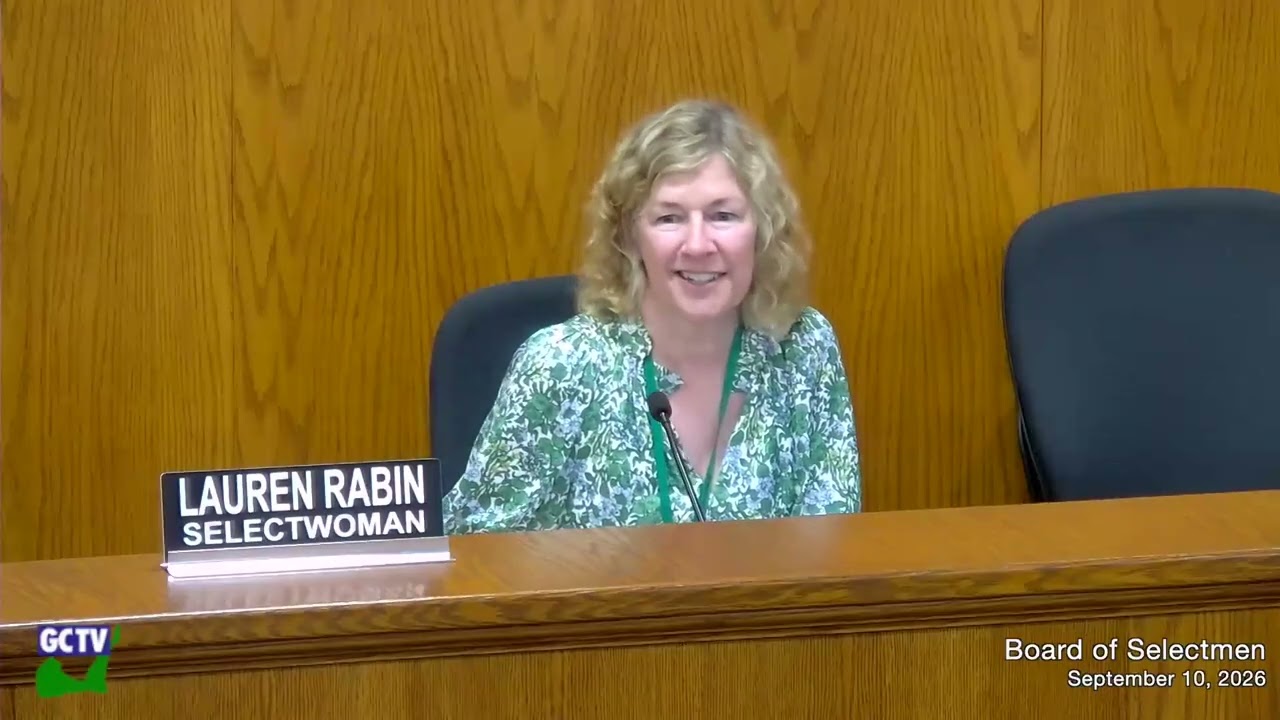
Board of Selectmen · Meeting of September 10, 2026
Greenwich Selectmen advance a long-sought Byram dog park and hear a pointed flood-study request from Millbrook. The board voted 3-0 to refer the dog park at Byram Park to Planning and Zoning for municipal improvement status, with Byram Neighborhood Association chair Liz Eckert telling the board "the great majority is in favor." First Selectman Fred Camillo, Selectman Lauren Rabin and Selectman Kahn also approved 3-0 an amendment barring the feeding of wildlife in town parks. Separately, Millbrook resident Scott Roth pressed the board for a new flood study, saying storm-flow estimates for his neighborhood's waterway range from 1,400 to 3,500 cubic feet per second depending on the agency, and that a state study never examined one home that has flooded 15 times.
"We just don't believe them," Roth said of state assurances. No vote was taken on the flood study.
In the full story:
- Who Was There
- Organizations And Documents Referenced
- The complete report — 2,838 words
Source: the Board of Selectmen meeting of September 10, 2026, reported from the official video recording and transcript.
The Full Article
Minutes and Administrative Business
The board opened with three routine votes approving minutes from the special meetings of August 25 and August 26, 2026, and the regular meeting of August 27, 2026. First Selectman Fred Camillo noted the August meetings were largely devoted to interviews for a school building committee. Selectman Lauren Rabin moved each approval, Selectman Rachel Kahn seconded, and all three passed 3-0 with no discussion.
Selectmen's Updates
Camillo's update ran long, covering a dense calendar of town events: the opening of a De Chico's grocery store in central Greenwich, a family-run business founded by three brothers who emigrated in the late 1950s; an upcoming restaurant opening over the South River in Byram, still moving through permitting; ribbon cuttings for Restoration Hardware and the Greenwich Book Fair; a bench dedication honoring the late founder of Richards clothing store; and the 25th-anniversary commemoration of the September 11 attacks, at which Mark Turner and former U.S. Rep. Chris Shays were scheduled to speak. Camillo noted 33 of the roughly 3,000 Americans killed that day were Greenwich residents or had direct town ties.
Camillo also flagged committee vacancies: the Energy Management Advisory Committee was recently expanded by two members and is seeking a new appointee, and the Commission on Aging was expanded from seven to nine members, also creating openings. He said the Selectman's Nomination Advisory Committee, which does not meet over the summer, resumes next week after spending recent months vetting appointees to the building committee overseeing the Greenwich High School natatorium, tennis courts and access roadway project.
Rabin used her update to note her personal excitement about the De Chico's opening, saying the Pemberwick-Glenville area had gone roughly three years without a nearby supermarket after the closure of a prior Grand Union and Stop & Shop. Kahn highlighted September as Hunger Action Month, saying Neighbor to Neighbor's client base has grown 13 percent over the past year amid rising food and gas prices and cuts to federal food assistance. Kahn also reported on the Greenwich Land Trust's 50th anniversary, noting the organization protects 1,014 acres across 82 preserves townwide, and previewed a September 21 public hearing on an "Art Street" building project and a September 23 conversation with Connecticut Secretary of the State Stephanie Thomas.
Rabin separately updated the board on the Julian Curtis School building project, saying a September 14 ribbon-cutting will mark completion of the first three phases, including fully renovated cafeteria space that received its certificate of occupancy in time for the start of school. The final phase, ADA-compliant classroom renovations, is funded in next year's Board of Education capital budget with design and bidding expected this fall and completion targeted for 2027. Rabin also reported the Conservation Commission's food scrap program, launched in July, has been well received, and that its Byram Branches tree-planting program closed its fall application round on August 15 with 48 tree-site submissions; staff plan to attend a September 15 Byram Neighborhood Association meeting to discuss the program further. Kahn reminded colleagues that the building committee overseeing the new Central Middle School retains formal ownership of that project until it is turned over to the Board of Education, and urged residents with feedback to continue engaging the committee directly.
Byram Park Dog Park: Referral to Planning and Zoning
Background and stakes: Advocacy for a Greenwich dog park dates to 2000, according to Camillo, who said he was among the first proponents. The town's existing dog park at Grass Island opened in 2005 after a five-year approval fight marked by resident concerns over lawsuits, declining property values and unleashed dogs — concerns Camillo said never materialized. The board has since sought sites on the town's east and west sides; the Byram Park location emerged as a candidate because the space was already fenced and contained.
The question before the board: whether to refer the proposal to the Planning and Zoning Commission for consideration of municipal improvement, or MI, status, the procedural gateway to formal site plan and zoning review.
Substantive content: Joe Siciliano, the town's director of parks and recreation, presented alongside Dan Carlson, who prepared a site outline and map in response to questions raised at the board's prior meeting. Camillo announced that Carlson and his wife had a son, Charlie, in the two weeks since that meeting. The proposed dog park site sits 535 feet from Byram Beach's waterline, farther than the 312 feet separating the Grass Island dog park from the water — a distance Siciliano's team increased specifically to address water-quality concerns tied to Byram Beach's history of bacterial issues. Camillo said the town has an interested private partner willing to help fund the project under a public-private partnership model, and estimated incremental maintenance costs at roughly $1,200, since Parks Department staff already service the area. Oversight would be folded into the duties of the town's newer park ranger program. Parking would draw on roughly eight existing spaces near the park entrance, plus a dedicated handicapped space adjacent to the dog park itself; Camillo said beach permits are required to use those spaces during the summer season, a detail Rabin asked be clarified in any public-facing Q&A materials.
The deliberation: Liz Eckert, chair of the Byram Neighborhood Association, told the board she had informally surveyed neighbors, including through a Facebook post, and found strong support. "I've done an informal talking to neighbors, put something on our Facebook page, and it seemed like the majority, the great majority, is in favor of the dog park," Eckert said, thanking the board for planning to attend the neighborhood association's September 15 meeting. Camillo separately thanked Eckert for her ongoing correspondence with the state Department of Transportation over graffiti and encroachment-permit issues in Byram, saying DOT had grown less responsive over time but that a newer staff contact appeared more engaged. Camillo acknowledged residents on the town's east side are still pressing for their own dog park and asked for patience, saying, "It's a good start," before the board turns attention there next.
Procedural steps and outcome: Rabin moved that the board approve the request for referral to the Planning and Zoning Commission for consideration of MI status for the dog park at Byram Park. Kahn seconded. The motion passed 3-0, with Camillo, Rabin and Kahn all voting in favor. Camillo clarified the vote does not confer MI status itself, only forwards the matter to Planning and Zoning, where site plan and coastal review will follow.
Implications and what is next: The project now moves to the Planning and Zoning Commission, where Camillo said additional questions from residents are expected. No timeline for a Planning and Zoning hearing was given at the meeting.
Ordinance Amendment: Feeding of Wildlife in Town Parks
Background and stakes: The board considered a second read of a proposed amendment to Town Code Section 7-24, governing the feeding of fish and wildlife in parks, open space and other properties managed by the Parks Department. Camillo said the item responds to a small number of residents who feed deer and other wildlife at locations such as Todd's Point.
The question before the board: whether to approve amended ordinance language allowing enforcement against wildlife feeding, ahead of a required vote at the Representative Town Meeting.
Substantive content: Camillo said the amendment is a "simple fix" to existing language that will allow the town to post signage and enforce a feeding prohibition. He credited town staff members Sarah and Beth with drafting the language across two departments. Siciliano noted, informally, that norms around feeding wildlife in town parks — recalling childhood visits to Brewster Park to feed ducks — have shifted as the town has moved to discourage the practice.
The deliberation: Camillo said he had heard mixed but largely supportive feedback and no organized opposition, though he noted "some other communication" had come in about the proposal without detailing its content.
Procedural steps and outcome: Rabin moved to approve the request to amend Town Code of Ordinances Section 7-24 regarding feeding of fish and wildlife in parks, open space and other town properties. Kahn seconded. The motion passed 3-0. The amendment next requires action by the Representative Town Meeting to take effect, since it involves a change to town code language.
Implications and what is next: Once ratified by the Representative Town Meeting, the amendment gives the Parks Department clearer authority to post signage and enforce against wildlife feeding townwide.
Playground Proposal: Held for Board of Parks and Recreation Review
Camillo noted a separate playground proposal on the board's agenda, developed with resident Phil Browse, would first go before the Board of Parks and Recreation before returning to the Board of Selectmen. Camillo said Browse "wasn't ready" to present and the item would be held pending that review. No further action was taken, and no vote occurred on this item.
Citizen Request: Flood Study for Millbrook, South of the Post Road
Background and stakes: Millbrook residents Scott Roth, David Levine and Paul Barrett came before the board to request town support for a comprehensive flood study of their neighborhood, a roughly 183-home community south of the Post Road near Exit 4. The request follows a long-running dispute with the Connecticut Department of Transportation over its plan to rebuild the Route 1 bridge spanning a waterway that flows through Millbrook's two internal lakes before reaching Long Island Sound. Roth said the DOT project has been in development for approximately 15 years and would raise the bridge roughly three feet while enlarging its opening to about four times its current size, a change designed to relieve flooding north of the Post Road, where the town has budgeted roughly $35 million in related drainage work. Roth, who said he has lived in Greenwich since 1999 and in Millbrook since 2002, described a nine-year military background as a nuclear engineer and said he has filed extensive Freedom of Information Act requests, compiling flood records dating to 1955.
The question before the board: whether the town would fund or help coordinate a new, full-reach hydraulic study of the Millbrook waterway before the state's bridge project proceeds, and would convene the state Department of Transportation, the state Department of Energy and Environmental Protection, town Public Works and the Millbrook Owners Association as stakeholders.
Substantive content: Roth presented a slide deck citing a series of prior studies by consulting firm CDM Smith in 2009, 2012 and 2023, augmented in 2024, which he said covered the waterway's upper reach north of the Post Road but stopped roughly 1,000 feet downstream of the bridge, short of the most flood-prone Millbrook properties. He cited one home, owned by a longtime resident he identified as Elias Cullen Cundes, that a state study concluded would never flood even in a 500-year storm, despite flooding 15 times since 1962. Roth said estimates of the waterway's peak storm flow vary widely depending on the source: FEMA figures put it at 3,500 cubic feet per second, a 1956 town study at 2,230, a CDM Smith study at 1,700, and a state estimate at 1,400. He said none of the estimates have been calibrated against actual field measurements in Millbrook, unlike the calibration CDM Smith performed for its work north of the Post Road. Roth also presented a 1908 historical map from the Greenwich Historical Society showing Millbrook's upper lake predates the community's 1920s-era development, disputing a claim he said he had heard that the neighborhood's flooding lakes were artificially created. He noted a regional program through the Western Connecticut Council of Governments identified 159 town properties eligible for flood-mitigation funding roughly two years ago, including three homes on Appletree Lane in Riverside that have since been elevated. Colleague David Levine, Roth said, separately discovered that roughly $500,000 had been included in a prior town capital budget for design, permitting and construction work on two Millbrook spillways and a related Davis Park spillway, but that the appropriation was rejected by the Representative Town Meeting.
The deliberation: Roth said his past attempts to raise concerns directly with the Connecticut Department of Transportation were rebuffed. "And when we met with them, they really didn't want to talk to us. They said, talk to our lawyer," he said, adding that the Millbrook Owners Association subsequently spent "a few hundred thousand bucks" on legal fees without resolution. Camillo acknowledged the pattern, saying the town has found the state's engineering division "a little tougher" to work with on this project than others, and said an earlier attempt to bring in an independent third party through the state attorney general's office went unanswered. A town engineer identified in the discussion only as Jim told the board he has been in periodic contact with state officials over the past decade or more and that, as of roughly six months ago, the state indicated the bridge project was on hold while it worked through unresolved drainage questions of its own. When Rabin asked directly, "Drainage questions from Millbrook?" Jim responded that the questions came "from a variety of different" sources, not solely Millbrook. Camillo pressed on whether the study could be folded into a separate state planning and environmental linkage study already underway along Interstate 95 that touches portions of the Post Road; Jim said that study's scope leans toward traffic rather than drainage but that he would raise the question with that project team. Roth, closing his presentation, said he was not asking the town to abandon the bridge repair but to pair it with restrictor infrastructure similar to what the town required on the North Street Bridge project, or to pursue a coordinated study before construction proceeds: "Let's do it properly and get the study first to see what we're dealing with."
Procedural steps and outcome: No motion was made and no vote was taken on the flood study request. Camillo said the town would follow up with the state on the possibility of a joint study and indicated interest in convening Millbrook residents, the state and town departments for further discussion, though no date was set.
Implications and what is next: The Route 1 bridge project remains on hold pending the state's own unresolved drainage questions, according to the town engineer identified as Jim, giving Millbrook residents a window to press for inclusion in future planning. No town funding commitment or study timeline was established at this meeting; residents indicated they intend to continue pushing for one before the state resumes design work on the bridge.
First Selectman Fred Camillo, presiding. Selectman Lauren Rabin, present and voting. Selectman Rachel Kahn, present and voting. Joe Siciliano, Director of Parks and Recreation, presented on the dog park referral and the wildlife-feeding ordinance. Dan Carlson, who prepared the dog park site outline and map, participated remotely. A town engineer referred to in discussion only as Jim addressed the Millbrook flood study request and DOT coordination. Scott Roth, Millbrook resident of Woodside Drive, presented the flood study request. David Levine, Millbrook resident, attended in support and was credited with identifying a prior town budget appropriation. Paul Barrett, described by Roth as representing the Millbrook Owners Association, attended in support. Liz Eckert, chair of the Byram Neighborhood Association, spoke in support of the dog park. Phil Browse, a resident working on a separate playground proposal, was referenced but did not present; the item was held for Board of Parks and Recreation review first.
Millbrook Owners Association — represented by Paul Barrett and residents Scott Roth and David Levine in the flood study request. Byram Neighborhood Association — represented by chair Liz Eckert in the dog park discussion; town staff planned to attend its September 15 meeting on both the dog park and the Byram Branches tree program. Connecticut Department of Transportation — owner of the Route 1 bridge project central to the Millbrook flood dispute; described by residents as unresponsive to direct outreach. Connecticut Department of Energy and Environmental Protection — cited as the agency from which the state needed a floodplain-impact exemption for the bridge project. CDM Smith — engineering consultant that has conducted flood studies of the waterway north of the Post Road in 2009, 2012, 2023 and 2024, cited repeatedly by Roth as a model for the study he is requesting. Western Connecticut Council of Governments (WestCOG) — cited as the source of a roughly two-year-old program identifying 159 Greenwich properties eligible for flood-mitigation funding. Greenwich Historical Society — source of a 1908 map Roth used to argue Millbrook's upper lake predates the community's development. Greenwich Land Trust — marked its 50th anniversary at a town proclamation the night before the meeting; cited by Selectman Rachel Kahn as protecting 1,014 acres across 82 preserves. Town Code of Ordinances Section 7-24 — the wildlife-feeding provision amended at this meeting, pending Representative Town Meeting ratification. Representative Town Meeting (RTM) — must ratify the Section 7-24 amendment; previously rejected a roughly $500,000 capital appropriation for Millbrook-area spillway work cited by Roth.