

Greenwich Budget Committee approves $1.2 million in appropriations
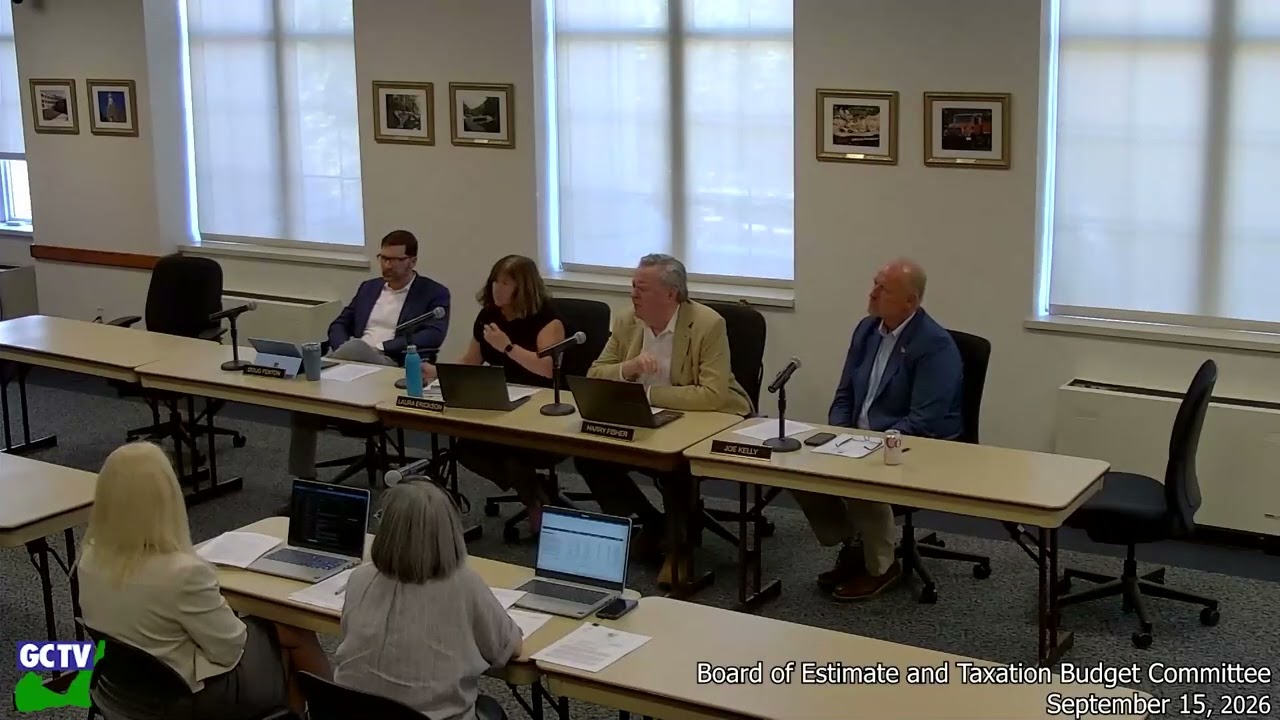
Other Committee · Meeting of September 15, 2026
Greenwich Budget Committee clears $1.2 million in grants and legal costs, opens sharp fiscal 2028 fight. Members voted 4-0 on six items including a $799,200 Greenwich Avenue signal overhaul, a $34,487.42 early-voting grant and two police grants, after a joint executive session in which the Law Committee separately approved a $420,000 legal settlement. Committee member Fisher pushed to cap operating-budget growth below 3 percent, citing 2.4 percent core inflation, while colleague Fenn warned that "resources go where they are needed" and a flat target risks starving under-resourced departments.
Another member argued for an "ensembled" inflation measure rather than a single CPI figure, citing a range of 3.5 to 4.2 percent. Staff also disclosed that Nathaniel Witherell's negative fund balance has grown past $7 million. No vote was taken on the fiscal 2028 guidelines, which return in October.
In the full story:
- Who Was There
- Organizations And Documents Referenced
- The complete report — 3,491 words
Source: the Other Committee meeting of September 15, 2026, reported from the official video recording and transcript.
The Full Article
Executive Session and Legal Settlements
Background and stakes: The Budget Committee and Law Committee, both subcommittees of the Board of Estimate and Taxation (BET), convene jointly when litigation involving the town requires both a legal decision and a funding decision. The question before the body: whether to appropriate town funds and approve settlement terms in two pending cases against the Town of Greenwich.
The committees opened in joint session at 1:07 p.m. and moved immediately into executive session on a motion by a member identified as Leslie, seconded by a member identified as Harry, to discuss the litigation privately. They returned to open session at 1:37 p.m., roughly 30 minutes later.
Once back in public session, the Budget Committee took up item SE1, a motion by committee member Fisher to approve a $120,000 additional appropriation connected to a case identified in the transcript as Prawn v. Town of Greenwich. The chair asked for discussion and called the vote; the outcome was not clearly stated on the recording, but the committee proceeded as though the item had passed, and a member's follow-up comment referencing "both cases" going forward indicates it was approved. Item SE2, a $151,762 additional appropriation for Southport Contracting v. Town of Greenwich, passed 4-0. Separately, the Law Committee approved a $420,000 settlement of a related case, captioned Sandra Prawn v. Town of Greenwich, by a vote of 2-0. A budget item designated SE3 was noted but not voted on.
After the votes, a Budget Committee member asked whether the two committees would consider treating appropriations of this kind as "routine" going forward, noting eight BET members were present across both committees. Another member deferred to "Stephen," and the group agreed to treat the items as routine at this point. The Law Committee then recessed to continue its own agenda in a separate conference room.
Implications and what is next: The settlement appropriations close out active litigation against the town; no further Budget Committee action on these cases was indicated.
Registrar of Voters: Early-Voting Grant and Election Policy
Background and stakes: Connecticut has issued the Greenwich Registrar of Voters office an annual grant for the past three years to help offset the cost of early voting, a cost the town does not build into its base budget because the grant amount is unpredictable year to year.
The question before the body: whether to accept and appropriate this year's grant for use on early-voting expenses.
Substantive content: Michael DiCaro of the Registrar of Voters office told the committee the grant totaled about $27,000 in 2024, $25,000 in 2025 and a little more than $34,000 this year. Unspent grant funds return to the town's general fund at year's end. DiCaro said his office and colleague Mary Hegarty, who sent regrets and did not attend due to a move, do not expect significant changes to the number of early-voting days in the near term, though he said both believe primary elections could be shortened from the current seven days once more data is available. For general elections, DiCaro cited turnout of more than 12,000 voters in the last presidential election as justification for keeping all 14 days of early voting, absent a second voting location, which he said would require costly additional network infrastructure. He said he and Hegarty remain committed to preserving all 12 polling places, which correspond to the town's 12 Representative Town Meeting districts, rather than consolidating them, even if staffing levels at each location are adjusted.
The deliberation: A committee member asked about press reports of interest in moving the state primary date from August to June or September. DiCaro said a September date is unlikely because of military-ballot deadlines, and noted that a prior case involving Greenwich, cited in the discussion as Campbell v. Bysiewicz, moved federal primaries to August without affecting municipal primaries, which are unaffected by overseas-voter rules. He said a June date would be "a perfectly good" option but that the Registrars have not taken a formal position. Another member raised the idea of a standing budget resolution to handle these grants automatically rather than bringing each one before the BET individually, noting some Finance Committee members had pushed back on that idea and wanted grants to continue receiving full review. DiCaro said he and Hegarty would raise the idea again with the Town Services Committee that evening.
"Mary and I are very committed to the concept of the 12 polling places that represent our 12 RTM districts. And should we make adjustments in the future, the adjustments might reduce the amount of staff in those polling places. But neither of us have any thought of or consideration to consolidate polling places." — Michael DiCaro, Registrar of Voters office
Procedural steps and outcome: Fisher moved RV1, an appropriation of the grant funds, seconded by another member. After a brief exchange over whether to round the figure to $34,487.42 or drop the 42 cents, the committee accepted the change and voted 4-0 to approve. Fisher recommended the item be treated as routine going forward; there was no objection.
Implications and what is next: The RV1 vote closes out this year's early-voting grant. The broader question of a standing budget resolution for recurring election grants, and of shortening primary early-voting days, remains open and is expected to surface again as the committee's Republican members indicated interest in exploring it this budget cycle.
Public Works: Greenwich Avenue Intersection Signal Project
Background and stakes: The intersection where Greenwich Avenue meets Railroad Avenue, Steamboat Road and Bruce Park Drive was originally included in a 2012 state grant covering signal work at six intersections near Exit 3, tied to a federally funded I-95 project. Because that broader project took nearly nine years to reach bid in 2021, and construction costs rose while the grant amount did not, the town pulled this intersection out to keep the larger project within budget. The design work, however, was already complete.
The question before the body: whether to accept a newly secured, separate state grant and appropriate town funds to replace the signal.
Substantive content: Commissioner Jim Michael of the Department of Public Works told the committee the town applied for a standalone grant for this intersection about a year and a half ago, was passed over in an initial award last October, but was told in spring 2026 the project remained a possibility and was notified in June that additional program funding had become available. The item, PW1, requests $799,200 in additional appropriation, the majority from the state grant, with the balance covering decorative crosswalks and pavement work the town intentionally deferred during its 2025 repaving of Greenwich Avenue and 2026 repaving of Railroad Avenue so as not to redo the work once the signal project began. Michael said the original 2012 grant allocation for this intersection was approximately $2.5 million. The redesign brings the signal up to current ADA and wind-load standards and adds a left-turn arrow for vehicles turning from Bruce Park Drive onto Steamboat Road and a right-turn arrow for vehicles turning from Steamboat Road onto Bruce Park Drive, timed to run simultaneously since the movements do not conflict.
The deliberation: Committee member Fenn, who also goes by Doug in the discussion, asked about the project's original grant amount and whether the redesign includes safety enhancements, describing the intersection as "confusing" and "accident-prone." Michael said the new turn arrows are intended to reduce conflicts between vehicles turning left off Greenwich Avenue and vehicles turning right off Steamboat Road, though traffic volume does not justify a dedicated left-turn arrow for Greenwich Avenue. Fenn also asked whether the signal would operate independently of the nearby Steamboat Road and Arch Street intersections, noting he has observed backups from the Arch Street signal affecting this one; Michael said the signals are tied together in a coordinated system but that volumes are low enough that changes at one should have minimal effect on the others, and said staff would review Fenn's observation. Fenn separately asked whether the signal timing could be reprogrammed if traffic patterns change because of nearby development, including a project at Mason Street and Bruce Park; Michael said signals have built-in flexibility for timing adjustments and that major new developments are required to submit traffic studies to the town as part of planning and zoning review. A budget staff member identified as Agnes and Michael discussed how the state grant revenue would be recorded, confirming the town will set up a revenue line in the capital fund to receive the grant, with the capital non-recurring appropriation covering only the difference between the grant and total project cost.
"In general, signals have ranges of how much green we can give to each cycle. We can modify the timing within those signals on our own and make those changes as necessary." — Jim Michael, Department of Public Works Commissioner
Procedural steps and outcome: The committee voted 4-0 to approve PW1. Fisher recommended it be treated as routine; there was no objection.
Implications and what is next: Construction timing was not discussed. The project closes out design work that has been on hold since 2012.
Police Department: DUI Enforcement and 911-Fund Grants
Background and stakes: The Greenwich Police Department sought approval to spend two previously awarded grants: a state DUI-enforcement grant for holiday-weekend overtime, and the town's regular allotment from the state's 911 surcharge fund.
The question before the body: whether to appropriate the grant funds for their designated uses.
Substantive content: Deputy Chief Securella, joined by Captain Eric Skorka of the patrol division, presented PD-1, an appropriation of approximately $34,276 from a DUI-enforcement grant used for overtime during Memorial Day, Independence Day and Labor Day weekend enforcement. Securella apologized for bringing the item late, saying the grant period actually ends September 26 and that the department had mistakenly believed the funding applied to the following fiscal year. He said the overtime spending has already occurred and the appropriation reimburses the payroll. He noted the department ranked among the top 10 in Connecticut for DUI enforcement this year and that an officer will receive a Mothers Against Drunk Driving award this week at Mohegan Sun for the fifth consecutive year.
PD-2, an $88,708.06 appropriation of 911-fund revenue covering July through December of this fiscal year, followed. Securella said the town's allotment from the phone-bill-funded 911 account fluctuates year to year and will be used primarily for dispatcher overtime, which remains elevated as the department trains its newly hired 15th dispatcher (with one more position to fill). Other funds are earmarked for an Automated Secure Alarm Protocol system, intended to route routine alarm-company calls directly into the dispatch system rather than tying up phone lines during high-volume events such as recent flooding; roughly $1,700 for replacement headsets; funds for new dispatcher chairs, which Securella said are used continuously and last five to six years despite their cost; and two $15,000 allocations for software and data-processing equipment, driven by a recent townwide power-outage tabletop exercise that identified a need for updated relocation-ready computer systems, including laptops, in case the department must dispatch from an alternate site.
Procedural steps and outcome: Both PD-1 and PD-2 passed 4-0 and were recommended as routine.
Implications and what is next: None indicated beyond continued monitoring of dispatch staffing and overtime costs through year's end.
Fiscal Year 2028 Budget Guidelines: First Read
Background and stakes: The Budget Committee's chair circulated a memo in late August, with attached exhibits prepared over the summer, proposing draft budget guidelines for fiscal year 2028. The memo builds on strategy guidelines the full BET approved in July.
The question before the body: whether the proposed guidelines, and in particular the target rate of budget growth, are appropriate for a first read ahead of a planned October vote.
Substantive content: The draft treats the "carry-forward," or status-quo, budget as a cap and asks departments to identify structural changes, particularly around labor, staffing, energy and technology costs, that could reduce the rate of increase over time. The carry-forward budget for combined town and Board of Education operating expenses shows an increase of about 3.5 percent, but the chair said the "total amount to be financed" line, which includes capital and debt items, is rising 4.11 percent.
The deliberation: Fisher said the committee's focus should be the "total operating cost line," which department heads can actually influence, rather than the total amount to be financed, which includes capital items outside department control. He said the guidelines should target an increase below 3 percent, citing a reported core inflation figure, excluding food and energy, of 2.4 percent. He also objected to language tying the memo to the capital tax levy, arguing department heads and the Board of Education have no control over that figure, and said the memo, at roughly six pages, was far longer than the one-and-a-half-page version circulated the previous year.
Fenn, addressed at points as Doug, said the committee should avoid a flat spending target because it works against a more important goal: directing resources to where they are actually needed rather than where they happen to be already allocated. He said departments facing rising service demand may need more resources, while others facing falling demand could operate with less. He said that once roughly a third of the budget tied to fixed contractual costs is backed out, department operating costs would need to grow by less than 2 percent to hit an overall sub-3-percent target, a reduction he called "very significant" for core departments.
"One of the goals I believe for our town should be that resources go where they are needed. Focusing various departments on a set budget works against that goal because there are areas that are probably under resourced and may need more resources to deliver the town services people expect." — Fenn, Budget Committee member
The chair, responding to both members, said the capital budget is projected near $150 million for fiscal 2028 and that the Board of Education expects to vote on its own capital plan in October. She said last year's increase in the capital tax levy to $5 million, which she described as bipartisan, has helped the town's fiscal position, and that the town faces a debt-policy violation in fiscal 2031 absent further action, a issue the Debt and Fund Balance Committee has been modeling using a capital model prepared by finance staff member Agnes. On fixed charges, she said healthcare costs remain a large and closely watched outlay that has historically returned savings to the general fund through vacancies, that the town's pension contribution could see favorable news after an actuarial review this fall, and that the town contributed $500,000 to its risk fund this year, half of last year's contribution, as a matter of ongoing fiscal discipline. She said the Board of Education's enrollment report is due in coming weeks, that special-education outplacement investments should be reviewed for savings if they are working, and that bus-parking logistics remain unresolved for fiscal 2028 even though the Board of Education solved the issue for fiscal 2027.
Fisher separately said Republican committee members continue to favor a larger capital tax levy increase of $5 million rather than $3 million for the coming cycle.
"In the latest inflation number reported last Friday, core CPI inflation, other than energy and food, was 2.4 percent." — Fisher, Budget Committee member
A member identified by the chair as "Matt" (addressed once by the chair as "Mr. Deshaun") raised concerns about relying on a single inflation metric, noting that while annual core CPI is 2.4 percent, the July-to-August monthly change of 0.3 percent would annualize to 3.6 percent. He proposed an "ensembled" approach combining multiple cost indices, including employment- and municipal-cost measures, arguing municipalities should weigh local labor-cost pressures rather than a single national figure. He said his own modeling using this approach showed inflation in a range of 3.5 to 4.2 percent, and cautioned against setting a target that "under-clubs" the real cost pressure town departments and labor contracts actually face.
"If you ensemble those numbers, look at those ensembled inflationary numbers rather than one metric for inflation." — Matt, Budget Committee member
Procedural steps and outcome: No vote was taken. The chair said the guidelines will return for a second read and vote in October.
Implications and what is next: The eventual target adopted, whether near 3 percent, 4.11 percent or something between, will bind department heads and the Board of Education as they build fiscal 2028 requests. The disagreement over whether to measure against the operating-cost line or the total amount to be financed, and over which inflation index to use, remains unresolved heading into that vote.
Nathaniel Witherell Fund Deficit
Background and stakes: Nathaniel Witherell, the town's skilled nursing facility, has run recurring operating losses that the town has historically funded at a level below the full loss, resulting in a growing negative fund balance.
Substantive content: Finance staff member Agnes told the committee the facility's negative fund balance now exceeds $7 million, after this year's losses, including capital and debt service, of $5.8 million were only partly offset by a $5 million town contribution, widening the gap by $800,000. Over the past five years, Agnes said, total losses including capital and debt have averaged about $5 million annually, or $25 million cumulatively, against roughly $17 million in cumulative town contributions.
The deliberation: Fisher asked whether it would be better to "true it up" by fully funding the loss rather than carrying a growing deficit. The chair called it "a thoughtful discussion that's had every year" and said she would advocate for more transparency about the facility's true cost to the town given the intensified focus on Nathaniel Witherell this cycle.
Implications and what is next: The deficit is expected to remain a focal point of the fiscal 2028 budget guidelines process.
Chair's Report and Routine Business
The chair previewed the October meeting, which she said will include the second read and vote on the budget guidelines, a year-to-date financial report for the first three months of fiscal 2027, a fiscal 2026 year-end snapshot, and a reconciliation of the town's authorized-but-unissued bonds ahead of a planned January bond sale. The committee then approved the minutes of its July 14, 2026 meeting 4-0. Member Kelly moved to adjourn; the motion passed 4-0 at 2:29 p.m.
Budget Committee chair, first name Laura per a colleague's reference, presiding; surname not given in the transcript. Fisher, Budget Committee member, identified himself as speaking for Republican members. Fenn, Budget Committee member, also addressed informally as Doug. Kelly, Budget Committee member, moved the adjournment. A member addressed as Matt (also addressed once as "Mr. Deshaun"), spoke on inflation methodology; attendance for vote-counting purposes unclear. A member identified only as Stephen was referenced regarding whether appropriations should be treated as routine; role and committee affiliation not specified. Leslie and Harry, who moved and seconded the motion to enter executive session; committee affiliation not specified. Michael DiCaro, Registrar of Voters office, presented RV1; Mary Hegarty, Registrar of Voters, was absent. Jim Michael, Department of Public Works Commissioner, presented PW1. Deputy Chief Securella, Greenwich Police Department, presented PD-1 and PD-2. Captain Eric Skorka (also referred to once as "Captain Sorga"), Greenwich Police Department patrol division commander. A finance staff member identified as Agnes prepared budget exhibits and answered questions on the Nathaniel Witherell fund and grant accounting. A staff member identified as Leo was asked to distribute a document to BET members.
Board of Estimate and Taxation — parent body of both the Budget Committee and Law Committee; eight of its members were noted as present across the two committees. Connecticut Department of Transportation — cited by Commissioner Jim Michael as the agency the town worked with on the original 2012 regional signal grant and the adaptive signal technology introduced through that project. Mothers Against Drunk Driving — cited by Deputy Chief Securella regarding an officer's fifth consecutive annual recognition, presented this week at Mohegan Sun. Prawn v. Town of Greenwich (SE1) and a related case, Sandra Prawn v. Town of Greenwich — litigation addressed in appropriation (Budget Committee) and settlement (Law Committee) votes. Southport Contracting v. Town of Greenwich (SE2) — litigation addressed in a Budget Committee appropriation vote. Campbell v. Bysiewicz (heard in the transcript as "Campbell versus Beisowitz") — cited by Michael DiCaro as the case that moved Connecticut's federal primary date to August without affecting municipal primaries. July 2026 BET strategy guidelines memo — cited by the Budget Committee chair as the foundation for the fiscal 2028 budget guidelines discussed at this meeting. Draft fiscal 2028 budget guidelines memo and Exhibits 1 through 3 — the packet materials under first read at this meeting, exhibits prepared by finance staff member Agnes. July 14, 2026 Budget Committee meeting minutes — approved at this meeting.