

Budget panel demands competitive bid, town oversight for Round Hill firehouse
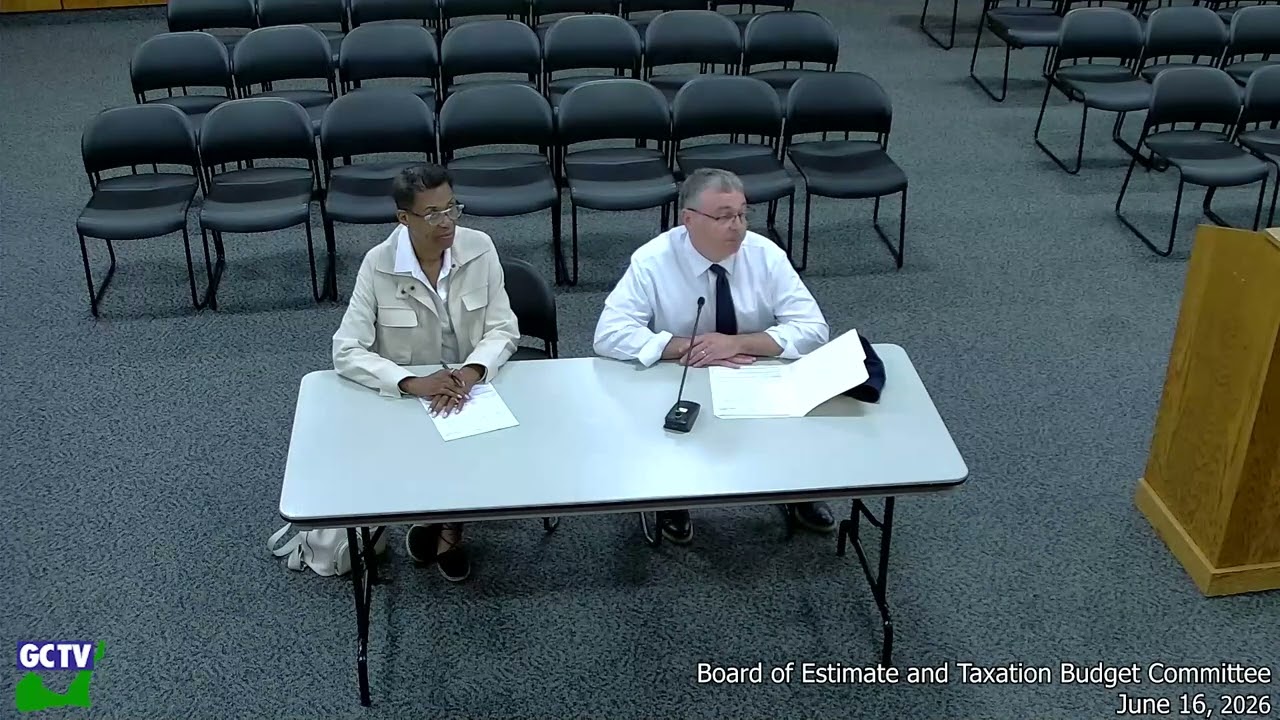
Other Committee · Meeting of June 16, 2026
Greenwich budget panel presses Round Hill fire company to accept competitive bidding on stalled $6 million firehouse. The BET Budget Committee voted 4-0 to carry forward $4.75 million already appropriated for the Round Hill Volunteer Fire Station, but member Harry Fisher said he has drafted a new condition, headed to the full Board of Estimate and Taxation on Monday, requiring public bidding and town oversight of construction. Fire company president David Chass said Round Hill has raised $1.25 million toward the project and warned that ceding control "puts us in a very difficult position." The committee also approved a $240,000 Nathaniel Witherell transfer, a Peterson Foundation-funded $110,000 Greenwich Library technician position, and $28,286.32 in "nip fee" waste-reduction grant funds.
TAG president Michael Miller told the panel replacement vehicles that once cost $50,000 to $60,000 now run $130,000 to $150,000, while insurance has topped $500,000 annually.
In the full story:
- Who Was There
- Organizations And Documents Referenced
- The complete report — 3,467 words
Source: the Other Committee meeting of June 16, 2026, reported from the official video recording and transcript.
The Full Article
Nathaniel Witherell fringe benefit transfer, NW4
The item was routine business: Nathaniel Witherell asked the committee to move $240,000 from its health insurance fringe-benefit account into supplies, materials and insurance line items, a transfer the nursing home makes most years when it runs a surplus in that account. Kelly Nardone, director of financial operations for Nathaniel Witherell, told the committee $70,000 would go to insurance, $70,000 to maintenance and general purposes, $2,000 to pharmacy and medical, $8,000 to custodial household supplies and $90,000 to food and dietary. Fisher pressed on the source of the surplus, noting the home's insurance costs actually rose, from $267,000 to $352,000, an 85,000-dollar, 32 percent increase driven by medical malpractice coverage, and asked whether the fringe-benefit surplus was also a function of fewer employees taking the town's health plan rather than purely favorable rates. Nardone said a lower headcount was "also possible." Fenton asked whether Nathaniel Witherell's fiscal 2027 budget projections for those same line items were more accurate than in past years; Nardone said yes, and that she had rerun year-to-date invoices that morning to confirm the request. The committee voted 4-0 to approve the transfer and classified it routine.
Greenwich Library AV technician position, GL3
Greenwich Library requested a new $110,000 position for an audiovisual support technician, to take effect July 1, the start of fiscal 2027. Library Director Joe Williams, joined by budget supervisor Arlene Grant, said the library is redesigning its Peterson Music Wing to include a public recording studio, and is running more AV-dependent programming both there and in the library's Berkeley theater space. The position, budgeted at $73,000 in salary and $37,000 in benefits, would be funded entirely by the Peterson Foundation, a private donor, with no cost to the town; the item had already cleared the HR committee by a 4-0 vote. Fenton asked whether the Peterson Foundation's funding commitment was open-ended or created any future expectation that the town would eventually absorb the cost. Williams said no: "This is a role that will be funded by Peterson," and that if Peterson funding ever fell short, the library would be forced to eliminate the position rather than shift it onto the town budget. That prompted a broader exchange about the age of the library's underlying agreement with the Peterson Foundation, which Williams said is 26 years old and contains outdated language, particularly around job titles. Fisher joked the agreement looked "written by somebody named Methuselah," drawing laughter; Williams agreed to work with the finance and law departments on an updated draft. The committee approved the position 4-0 and classified it routine.
Executive session: Sandra Pron v. Town of Greenwich
The committee moved into executive session at 1:11 p.m. to discuss one of two pending litigation matters listed on its agenda, Sandra Pron v. Town of Greenwich, and asked everyone not needed for the discussion to leave the room. It returned to open session at 1:26 p.m., fifteen minutes later. The chair noted that although a vote related to the matter appears later on the committee's agenda, no vote was expected or taken on the litigation at this meeting.
Conservation Commission nip-fee waste reduction grant, CC2
The committee approved $28,286.32 from the Connecticut DEEP Waste Reduction Grant program, funded by the state's five-cent fee on miniature liquor bottles, commonly called nips. Beth Evans, representing Greenwich's Conservation Commission, was joined by Julie Deschamps, a founding member of the nonprofit Waste Free Greenwich, in presenting the item. Evans said the funds have accumulated since October 2023 and represent a catch-up appropriation covering roughly a year and a half of collections, paid to the town twice yearly in amounts of about $5,000 per six-month period. The money supports a food-scrap recycling program in Greenwich elementary schools, covering hauling costs and container liners; Waste Free Greenwich hopes to expand the program to additional schools and potentially the Greenwich High School central kitchen. Deschamps explained that a separate $150,000 state legislative grant had funded the same program from 2023 until it expired June 30, 2025, after delays in the Department of Education finalizing the contract cut the usable grant period from a full year to three or four months, prompting an extension that ultimately ran through last June. Mark Bria, a Greenwich Public Schools facilities official, estimated ongoing costs at about $20,000 for ten months of hauling plus $3,000 for liners, or roughly $23,000 a year, enough to sustain the current program and cover an expansion to the high school kitchen. Fisher and the chair discussed whether the nip-fee revenue should be appropriated twice a year, as it arrives, rather than allowed to accumulate; Evans agreed that would be preferable practice. The committee approved the item unanimously and classified it routine.
Hamel Rink release of conditions, PW5
The committee released $50,000 tied to a fiscal 2022 funding condition for the Hamel Rink facility, clearing the way for the town to begin final design work. Commissioner of Public Works Jim Michael told the committee the release was needed to move the project forward after the RTM approved separate Hamel Rink funding "with flying colors" the previous night. The chair noted some confusion in tracking which of two related funding conditions, one from fiscal 2022 and one from fiscal 2026, had already been released, and asked that future cover sheets flag all outstanding conditions clearly rather than relying on department files. Michael said a separate $2.7 million fiscal 2027 condition is written to release automatically upon design approval and therefore required no committee action Tuesday. Asked by the chair whether the project remained on schedule to go out to bid next spring, Michael said that was still the department's goal. The committee approved the release 4-0 and classified it routine.
Capital carry forwards: Greenwich Point, Harbor dredging and Round Hill
The committee took up three capital carry-forward requests separately before handling nine additional items as a single omnibus motion, a housekeeping process the chair said the committee is required to perform annually under the town charter, though she noted policymakers are discussing lengthening that window for efficiency.
Greenwich Point Facility Improvement, a fiscal 2023 appropriation of $325,000, was carried forward to fund the town's portion of work on the Chimes Building at Greenwich Point, primarily septic and electrical upgrades, which the town performs in partnership with the Greenwich Point Conservancy under the oversight of Luigi Romano of the town's building construction and maintenance division. Commissioner Michael said the project had been delayed by ongoing legal agreements between the town and the conservancy, with plans now expected to be finished within six to twelve months. Fenton asked whether construction-cost inflation over the project's multiyear delay created risk of the number growing; Michael said the town hoped to hold the figure and would negotiate cost-sharing with the conservancy as the scope firms up. Fisher confirmed the conservancy funds and manages the design and rehabilitation work while the town retains review authority, and asked whether the Tod's Point Sailing School would need to relocate during construction; Michael said it would not. The committee approved the carry forward 4-0 and classified it routine.
Greenwich Harbor dredging, a fiscal 2020 appropriation of $2 million housed in the town's Harbor management account, drew a presentation from Ty Anderson, chair of the Harbor Management Commission, and consultant Jeff Stedman. Anderson said the $2 million represents the town's estimated cost share of a federal Army Corps of Engineers dredging project for the federal channel into Greenwich Harbor and the access channel to the Grass Island Marina, based on comparable costs from a similar Norwalk project. He said roughly half a million dollars in federal funding, secured with help from Congressman Jim Himes's office about a year and a half ago, has already paid for survey and material-testing work, which found that about half the material to be dredged is unsuitable for open-water disposal and will require construction of a contained aquatic disposal cell. "What we don't know at all, frankly, is when this money will be spent. But when the Army Corps is ready to do it, we have to have the money," Anderson said. He estimated construction would not begin before 2029, and said prioritization criteria for the Army Corps' dredging queue change year to year. Fenton asked when the preliminary survey work is expected to finish; Stedman said the commission has been asking the Army Corps that question for the better part of a year without a firm answer. The committee approved the carry forward unanimously and classified it routine.
Round Hill Volunteer Fire Station drew by far the longest discussion of the meeting. The committee carried forward two appropriations, $100,000 and $4,650,000, both dating to roughly fiscal 2020, with a later interim appropriation added in fiscal 2024. David Chass, president of the Round Hill Volunteer Fire Company and chair of its building committee, said the company has design approval, a current building permit and temporary electric service installed two years ago, but ran into a "stumbling block" with its general contractor that increased the project budget and halted progress in fall 2024. Chass said Round Hill has raised $1.25 million toward the project, including $750,000 in private donations and a $500,000 Connecticut state grant, but has been unable to solicit additional donations because its original capital-campaign donors have grown wary after repeated false starts. He estimated the total project cost at roughly $6 million, meaning the company may need $1.1 million to $1.2 million more than the town has already appropriated, and said he hoped to bring refined numbers back to the BET in August, with a goal of beginning renovation in October.
Fenton walked through the project's timeline since the RTM approved an interim appropriation in June 2024: Round Hill mobilized with its contractor and planned to start work in September 2024, but when a new town administrator, who joined that September, raised concerns about the contractor's bonding, the project stopped while the town's legal and finance departments reviewed the process. Chass said the goalposts had moved three times through no fault of Round Hill's: an original contractor was disqualified when a state ruling required the project follow prevailing-wage rules; a second contractor, AP Construction, was selected at a reduced rate and has spent two years value-engineering the project; and bonding requirements tied to the state grant then forced further review. "The problem is that the goal posts have changed three times on us from when this project began through no fault of ours," Chass said.
The chair said the state grant carries requirements, including what she and Fisher characterized as a clear expectation of competitive bidding, that the town believes Round Hill has not yet satisfied, and said town administration and legal counsel need to review Round Hill's documentation "to a T." A newer committee member pressed Chass on who leads the project day to day; Chass said he serves as the lead, an owner's representative in residential real estate, supported by former Round Hill chief and now assistant chief Rick Strain, who has decades of construction experience, and architect Tim Sharp. Fisher, drawing on his own review with Luigi Romano of how the town-run Chimes Building project was structured, said he had drafted a condition to present to the full BET on Monday, June 22, that would require: acceptance of the design by the Greenwich Fire Department; Planning and Zoning sign-off if the design changes, since any modification would trigger the newer building code and raise costs; a more detailed fundraising report from Round Hill, with Fisher noting he does not consider the $500,000 state grant true "fundraising"; a mortgage filed for the amount of the town's contribution; and a management agreement giving the town's building construction and maintenance division, under the Department of Public Works, full oversight and authority, including public bidding for all aspects of the project. Fisher said implementation would run through the first selectman's office and town administrator, not the BET directly.
Chass objected strongly to ceding project control. "We are going to be responsible for the maintenance for the next 20, 30, 40, 50 years of that project. So, to not have control over that project puts us in a very difficult position," he said. The chair replied that the scale of town investment, in excess of $6 million in what remains privately owned property, required stronger protection than the current mortgage agreement provides, adding she was uncertain the property's assessed value, per the town's tax card, even reaches $6 million. Fenton asked Fire Chief McHugh whether any other Greenwich volunteer fire station is privately owned; McHugh said none are, making Round Hill the only such case. Chief McHugh and Assistant Chief Charlie, whose surname was not clearly captured in the recording, also confirmed the approved design has not changed since Planning and Zoning approved it in 2020 and does not add a new bay, though the building's mechanical, electrical and plumbing infrastructure was engineered to allow a future addition for career staff without additional cost. Chass separately updated the committee that a Round Hill water tanker under repair remains on track to return to service by July 4, and confirmed the town has separately appropriated funds for a second tanker truck to be housed at the station.
The committee voted to carry forward the $4,750,000 in prior appropriations and classified the item non-routine, signaling it will need further review at the full board level. No vote was taken Tuesday on Fisher's proposed oversight condition itself; that will go before the full BET on Monday, June 22.
Omnibus capital carry forward
The committee approved, as a single motion, nine additional capital carry-forward items spanning the Bruce Museum, four Department of Public Works projects, one fire department project, one first selectman's office project, one Nathaniel Witherell project and two parking services projects. The chair declined to read each dollar figure aloud, noting a breakdown is included in the meeting packet. The omnibus motion passed unanimously and was classified routine.
TAG financial and program update
The committee heard an extended, non-voting update from Michael Miller, president of TAG, ahead of a scheduled release of the second half of the nonprofit's annual town funding later this year. Miller said TAG provides specialized ADA-accessible paratransit transportation for seniors, the disabled and school-age youth, delivering more than 70,000 rides annually through a mix of core, town-supported programs and self-funded "expanded" programs that generate positive cash flow, typically topping $100,000 a year, to help subsidize the core service. TAG's core programs, led by the state-mandated Dial-A-Ride service it has run since 2007, require about $400,000 in community support annually; the town provides roughly $300,000 of that, with the remainder from TAG fundraising and surplus from its expanded programs.
Fenton noted the town's funding request to TAG has stayed flat for four or five years despite rising costs and asked how the organization has managed it. Miller credited growth in TAG's largest expanded program, a competitively bid Connecticut Department of Transportation paratransit contract that began at $3 million and, after the state asked TAG to take on additional riders, will finish its initial five-year term near $6 million; the state has asked TAG to extend the contract an additional year, through June 2028. Miller said the contract includes built-in annual escalations that have offset cost increases, though not as fully as originally projected, leaving the contract "still cash flow positive, just not as positive as it would have otherwise been."
Miller detailed two areas of dramatic cost growth: vehicles that cost $50,000 to $60,000 before the pandemic now run $130,000 to $150,000, and annual financing costs per vehicle have risen from roughly $9,000 to over $24,000 amid higher interest rates. Insurance for the fleet, despite what Miller called a "pristine" safety record, has more than doubled from under $200,000 to over $500,000 annually industry-wide. He also recounted TAG's 2017-18 near-collapse, when the organization lost roughly 60 percent of its revenue after losing major contracts to lower-cost bidders, suffered over $600,000 in operating losses, and saw its bank line of credit cut from $250,000 to $100,000, depleting its cash reserves. During the pandemic, Miller said, TAG pivoted to the Feed Greenwich program alongside Neighbor to Neighbor and the town's Department of Human Services, making more than 72,000 home deliveries and distributing over 800,000 pounds of groceries, while securing $1.1 million in external pandemic grants and loans, including a $500,000 SBA loan, to sustain operations. Vehicles are financed through a mix of leases and loans, built into TAG's annual operating budget. Asked about risk, Miller said the DOT contract is secure through at least 2027, likely 2028, and that any loss of an expanded program would reduce the surplus subsidizing core services, potentially forcing TAG to seek additional town funding or cut service. Committee members thanked Miller for the transparency; no action was taken.
Comptroller's year-end update and minutes approval
Comptroller Joan Lynch gave a brief close-of-year update, saying the town has two weeks left before the June 30 fiscal year-end and expects results in line with, or slightly better than, what she presented at the previous month's meeting. She flagged that new property tax bills reflecting the town's revaluation and new mill rate go out by mail Wednesday and become available for online payment Thursday, and noted the July committee meeting remains available for any late transfers, including a small number the Board of Education finance team expects to bring forward. Separately, the chair asked about the status of Board of Education capital projects, none of which appear on this cycle's carry-forward list; Lynch confirmed all remaining open Board of Education projects have encumbered funds and are technically in compliance, even amid the pending departure of a staff member identified as Mr. Watson, whose position, she said, is being filled through an active search led by a staffer identified as Ben. The committee then approved the minutes of its May 12, 2026 meeting by a 4-0 vote and adjourned.
Committee chair, referred to in the meeting only as Laura, surname not stated Harry Fisher, committee member and public safety liaison Fenton, committee member (first name not stated) Doug, committee member (surname not stated) David Weissbrod, the committee's other public safety liaison, referenced in discussion but not confirmed present Joan Lynch, Comptroller Leo, committee staff (surname not stated) Leah, committee staff (surname not stated)
Presenters and public participants: Kelly Nardone, director of financial operations, Nathaniel Witherell Joe Williams, director, Greenwich Library Arlene Grant, budget supervisor, Greenwich Library Beth Evans, Conservation Commission Julie Deschamps, founding member, Waste Free Greenwich Jim Michael, Commissioner of Public Works Ty Anderson, chair, Harbor Management Commission Jeff Stedman, consultant to the Harbor Management Commission David Chass, president, Round Hill Volunteer Fire Company, Inc., and chair of its building committee Greenwich Fire Chief McHugh Assistant Chief Charlie (surname unclear in recording) Rick Strain, assistant chief and building committee member, Round Hill Volunteer Fire Company Tim Sharp, architect for the Round Hill project Michael "Mike" Miller, president, TAG Mark Bria, facilities official, Greenwich Public Schools, cited for a program cost estimate
Peterson Foundation — private funder of the new Greenwich Library AV technician position, GL3 Waste Free Greenwich — nonprofit partner in the elementary school food-scrap recycling program funded by item CC2 Connecticut DEEP Waste Reduction Grant ("nip fee") — state five-cent fee on miniature liquor bottles, source of the $28,286.32 approved under CC2 RTM (Representative Town Meeting) — approved separate Hamel Rink funding the night before this meeting, cited in support of item PW5 Greenwich Point Conservancy — town's partner on the Chimes Building improvements funded under the Greenwich Point Facility Improvement carry forward U.S. Army Corps of Engineers — federal agency conducting the Greenwich Harbor channel dredging project tied to the $2 million Harbor carry forward Congressman Jim Himes's office — credited with securing roughly $500,000 in federal survey funding for the harbor dredging project Greenwich Planning and Zoning Commission — approved the Round Hill firehouse design in 2020, cited throughout the Round Hill discussion AP Construction — general contractor currently engaged by Round Hill Volunteer Fire Company for the firehouse renovation State of Connecticut grant program — provided $500,000 toward the Round Hill project, administered with assistance from Representative Steve Meskers's office Connecticut Department of Transportation — party to TAG's paratransit services contract, discussed in TAG's update Feed Greenwich / Neighbor to Neighbor / Greenwich Department of Human Services — partners in TAG's pandemic-era food delivery program Bruce Museum, first selectman's office and parking services — departments whose capital carry-forward items were approved as part of the omnibus motion May 12, 2026 BET Budget Committee meeting minutes — approved by the committee at the close of this meeting