

Greenwich finance board attaches conditions to fire station funding
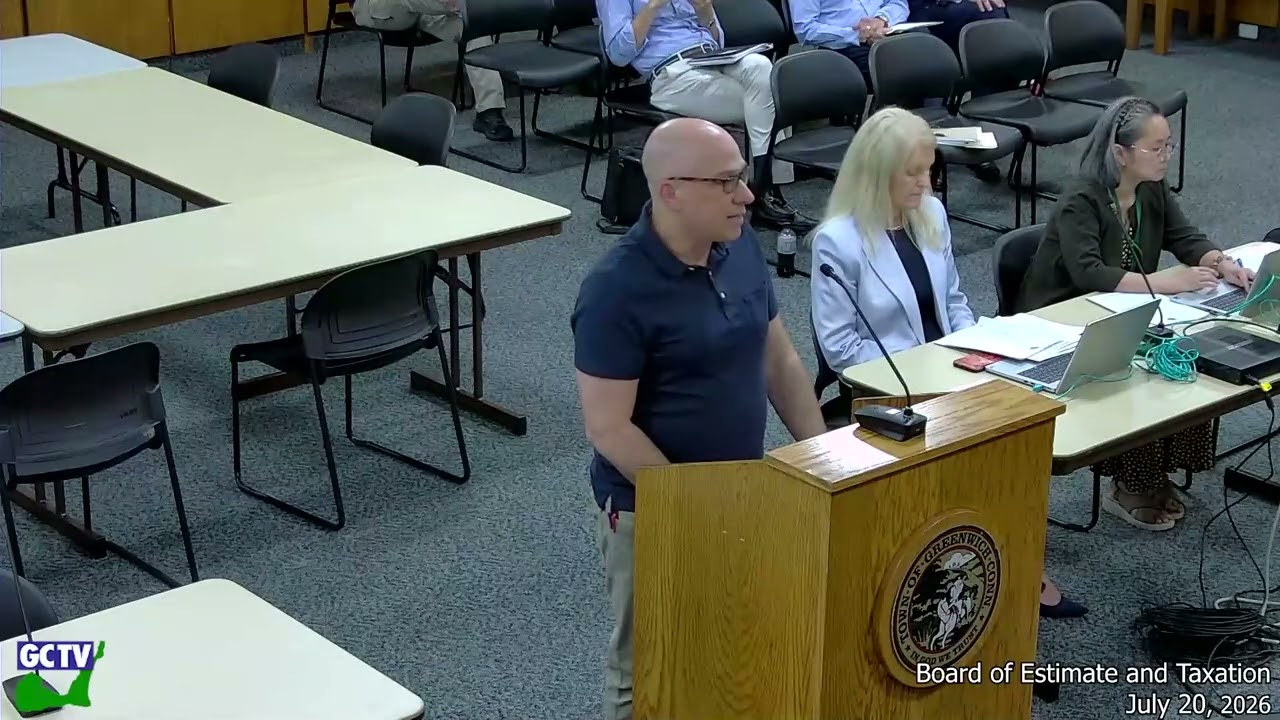
Other Committee · Meeting of July 20, 2026
Greenwich finance board attaches conditions to $4.65 million fire station funding. The Board of Estimate and Taxation voted 11-1 to require a first selectman's policy statement, fire department design sign-off, public bidding and town oversight before releasing Rounds Hill Fire Station construction money, over budget chair Laura Ericson's objection that it was "overreaching." Controller Joan Lynch reported an early $2 million fiscal 2026 general fund surplus and a 149.4 million dollar cash balance. Nathaniel Witherall leaders disclosed a roughly $5 million operating loss and talks with the Waveny Life Care Network, prompting member Sally to note the loss equals "about $800 a household" across Greenwich's roughly 5,800 households.
The board also gave final approval to a fully rewritten BET reference manual and adopted fiscal 2027-28 budget strategy guidelines, 11-0 with one abstention.
In the full story:
- Who Was There
- Organizations And Documents Referenced
- The complete report — 4,218 words
Source: the Other Committee meeting of July 20, 2026, reported from the official video recording and transcript.
The Full Article
Assessor's Report
The board's meeting opened with Assessor Lauren Elliott's monthly report. Tax bills went out June 17 and are due back August 3 this year because August 1 falls on a Saturday. New certificates of occupancy issued since October 1 will add roughly $223,716 in additional tax revenue to this year's grand list. The elderly homeowner tax-relief program grew to 189 qualified applicants, up from 188 the prior month, after an additional filer secured an extension through the state Office of Policy and Management; Elliott said the increase raised the total benefit by roughly $3,400. June recorded 65 property sales, up from 54 in May.
Asked by the chair to put the reval cycle in context, Elliott reported 98 tax appeals filed to date, 68 commercial and 30 residential, well below the 166 appeals filed in 2015 and 134 in 2010. The board's most recent full revaluation year, 2021, saw only 68 appeals, a figure Elliott attributed partly to pandemic-era conditions. "Considering the amount of increase that we had this year overall in the residential and just in the overall grand list, I was happy to see it under a hundred," she said. She noted 12 of the 30 residential appeals and a number of the commercial appeals are from repeat filers. The board voted unanimously, on a motion by Mr. Alche and a second from Leslie Tarkington, to accept the report.
Executive Session
The board recessed into executive session at 6:34 p.m. to discuss a pending litigation matter, on a motion from Laura Ericson seconded by Harry Fischer, and returned to open session at 6:41 p.m. on a motion from Ericson. Both votes were unanimous voice votes and no details of the litigation were discussed publicly.
Nathaniel Witherall Friends Funding
The board took up a routine item, NW1, approving use of $20,500 in funding from the Friends of Nathaniel Witherall. The item passed on a unanimous voice vote with no discussion.
Rounds Hill Fire Station Capital Carry-Forward
Background and stakes: The renovation of the Rounds Hill Fire Station, home to the Rounds Hill Volunteer Fire Company, has been in planning for roughly seven years, according to members who referenced its long history. The project's design was approved by the town's planning and zoning commission roughly six years ago. A $6 million-plus appropriation was made across two prior budget cycles plus an interim fiscal 2024 allocation, and the board's budget committee took up a fresh carry-forward request at its June meeting, voting 4-0 to send $100,000 for design and $4.65 million for construction to the full board. The item was deferred from the board's regular June meeting to Monday's session.
The question before the body: Whether to release the carried-forward construction and design funding, and whether to attach new conditions on that release given the project's long delay and the changing character of the surrounding area of town.
Substantive content: Fire company representative David Chass, appearing with members of the Greenwich Fire Department, asked the board to hold off on any new conditions until the fall, saying the fire company had "quite a few conversations to have" and wanted newer BET members to visit the firehouse and understand its history before conditions were imposed. Member Harry Fischer then moved to add a seven-part condition to the carry-forward, requiring, before release of any funds: a statement from the office of the first selectman on its current policy approach to the station; acceptance of the design by the Greenwich Fire Department; open access to on-duty career firefighting staff; approval, if needed, by the planning and zoning commission; a report on the fire company's fundraising; a first mortgage filed in the amount of the town's contribution; and a management agreement giving the town's building construction and maintenance division full oversight, including public bidding, on the project.
The deliberation: Ericson objected on process grounds. "I think placing a seven-part condition on an item that has already been appropriated in two past budget cycles plus an interim in fiscal 24 isn't necessarily a good practice from us," she said, adding she had no objection to most of the individual conditions but felt the board was "overreaching" on dictating firefighter access to what remains fire-company-owned private property. Matt Dashamp said he would support the conditions but singled out only the first two, the first selectman's policy statement and the fire department's design acceptance, as truly essential. Member Steve Selves said he ordinarily would side with Ericson on "mission creep" but supported the conditions given the project's history of delay. Joshua Brown offered a brief endorsement, saying the conditions "hopefully sends a signal that we're interested in getting to a final answer."
The Greenwich fire chief, invited to comment, said the department supports the Rounds Hill company "100 percent" and sees the renovation as an opportunity to expand service to a fast-growing part of town, but stopped short of endorsing the conditions outright, saying only that his department would work with the town and fire company to meet the first two. Chass pushed back most strongly on the seventh condition, giving the town full construction oversight of a privately owned building. "We don't believe that there is any precedent for the town running a project on private property," he said, adding a past town attorney had questioned whether it was even legally possible. He also disputed the substance of conditions one and two, saying the design and plan have not changed since 2018 and that a prior round of talks about career staff access at the station had already concluded, years ago, that the idea was not workable.
Procedural steps and outcome: Fischer's amendment passed on a roll-call vote, 11-1, with Ericson the lone dissent; Kelly, Bedar, Selves, Tarkington, Dashamp, Weissrod, Pellegrino, Alche, Fischer and Brown voted in favor, along with one additional yes recorded during the roll. The underlying carry-forward appropriation, as amended, then passed on a unanimous voice vote, with the chair noting the tally aloud but the exact count garbled in the recording.
Implications and what is next: No construction funds will be released until the first selectman's office issues a policy statement, the fire department signs off on the design, and the town and fire company negotiate the access and oversight terms Fischer's amendment requires. Both Fischer and Ericson indicated the underlying documents, the mortgage agreement and grant terms, may need to be reopened as part of that process, with further conversations expected before the board's September meeting.
Controller's Report
Controller Joan Lynch presented figures for the period June 23 through July 20, 2026, as the town closes its fiscal 2026 books. Early, preliminary estimates show a general fund surplus of just over $2 million; Lynch cautioned the figures will not be finalized until early September, in keeping with governmental accounting standards requiring the town to capture relevant July and August activity.
The general fund's invested cash balance was $149.4 million as of June 30, 2026, about $7.5 million lower than the June 30, 2025 balance, which Lynch attributed mainly to payroll timing and vendor payments. The general fund earned $316,000 in interest in June alone, a 3.8 percent monthly return, and $7.7 million for the full fiscal year at a blended rate of 4.02 percent. Prepaid taxes totaled $53.7 million as of June 30, 2025 and $54.7 million as of June 30, 2026, both representing about 12 percent of the total tax levy, which Lynch said reflects consistent taxpayer behavior around prepayment deadlines.
Ronnie Rash, senior executive account manager with the town's insurance broker Gallagher, presented the insurance renewal to the town's audit committee on July 16; Lynch reported total premiums came in well within the fiscal 2027 budgeted amount after competitive bidding. The town's retirement portfolio posted an 11.04 percent return for fiscal 2026, well above the town's 6 percent discount rate, with the plan's market value rising to $753.5 million as of June 30, 2026, up from $693.2 million a year earlier. Lynch said a final number reflecting the impact on the town's unfunded liability calculation will come in October.
On American Rescue Plan Act funds, Lynch said remaining allocations are mostly sewer-related and the town is working to ensure smaller remaining amounts are spent before the December 31, 2026 deadline. External audit work is ongoing, and the next round of internal audits will cover the Griffith E. Harris Golf Course and, at the Board of Education, the student activity fund and the school lunch program. Lynch also flagged several Board of Education summer budget transfers tied to a change in how the town fuels its buses, a water-damage repair at a school facility, and IT funding moved out of the special education budget.
Lynch closed with two items for the board's awareness: sharply rising costs for computer server and semiconductor memory, which has already doubled the price of virtual desktop infrastructure units the police department had budgeted to purchase, potentially forcing departments to request more funding or buy fewer units; and an update on the town's transition to automated accounts payable, with a fuller strategic presentation planned for the board's September meeting. The board voted unanimously to accept the report on a motion by a member identified in the recording as Mr. Cheek, seconded by Mr. Pellegrino.
Treasurer's Report
Lynch also delivered the treasurer's report. The town's OPEB trust portfolio had a market value of $68.5 million as of June 30, 2026, a fiscal-year return of 16.76 percent. At Nathaniel Witherall, Lynch noted the Vogel bequest has grown to $949,000 with earned interest, and that the town's affordable housing trust no longer holds any ARPA funds and is therefore no longer restricted. The board voted unanimously to accept the report.
BET Standing Committee Reports
Debt and Fund Balance Policy Committee chair Mr. Alche reported the committee postponed its vote on which capital projects should move to longer-term financing, with that vote now expected at the committee's September meeting. He also noted the committee approved, by a 4-0 vote, the reference-manual language defining its own charge.
Reporting for the CMS building committee and BET special project team, Harry Fischer delivered what he called good news: environmental testing for PCBs, delayed until the occupied school building was vacated for the summer, came back clean, meaning the roughly $1,084,000 reserved for potential abatement will not be needed. Of a $6 million appropriation for the project, $1.6 million had been held back subject to release; the committee is not seeking that release now but may return in the fall. Demolition of the old building, including the media center, which sat on the footprint of a planned new access road, is underway. Fischer said the school is expected to open by August 22, and the town has offered contractor Turner Construction incentive payments for weekend work in hopes of beating that date.
BET Reference Manual
Old business brought the final read of a wholesale rewrite of the BET reference book, a project led by Laura Ericson and Joshua Brown on the board's policies and procedures committee since January, with heavy staff work from Leo Berisha. Ericson described the new structure as "plug-and-play," assigning specific policies to specific standing committees and tracking review or amendment dates in each policy's footer, with a goal of reviewing every policy at least once per board term.
Three sets of changes were adopted before final passage. First, language proposed by the board's human resources committee, which had met earlier that same day and voted 4-0 to recommend it, was read into the record by Leslie Tarkington; it ties the HR committee's charge more explicitly to charter sections 217A, 217 and 179, and requires the committee to evaluate the fiscal impact of any staffing table changes and to route interim position-change requests through the budget committee before returning to the full board. Second, Joshua Brown offered five technical corrections: changing "minority caucus chair" to "minority caucus leader" in two places for consistency; deleting language limiting the chair's ability to recognize non-BET speakers during meetings; correcting a typo in the word "department" on page 11; and adding a reference to RTM district meetings, alongside the existing reference to RTM committee meetings, in the May timetable on page 22. Third, Ericson flagged two of her own substantive edits: removing manual language suggesting the BET's retirement board can grant postretirement cost-of-living adjustments without prior BET approval, which she said the town charter does not actually authorize, and declining to adopt a suggestion from Tarkington clarifying that the sewer fund is the town's only true pay-as-you-go fund, instead referring that question to the debt and fund balance policy committee for future study.
All three amendments and the manual as a whole passed on unanimous voice votes. Chairman Weissrod singled out Ericson, Brown and Berisha by name for what he called a "monumental" undertaking not attempted in roughly two decades.
Nathaniel Witherall Budget Update
Background and stakes: Nathaniel Witherall, the town's affiliated long-term care facility, returned to the board for the first time since being pressed in February to explain a declining census and revenue picture. The presentation came against the backdrop of the recent closure of the nearby Greenwich Woods long-term care facility and a $5 million operating loss for the fiscal year that just ended.
The question before the body: Whether the board should be reassured that Witherall's leadership has a credible plan to stabilize its finances, and what near-term relief, including a possible partnership, might look like.
Substantive content: Board chairman Peter Kelly opened by crediting staff for absorbing 23 long-term residents transferred from the closed Greenwich Woods facility without turning away any resident who wanted to come to Witherall, even while a previously approved $700,000 piping project, on budget, continues toward completion by late October or early November. Kelly said the board signed a mutual non-disclosure agreement on July 1 with the Waveny Life Care Network of New Canaan, a five-star-rated nonprofit long-term and short-term rehabilitation provider that also operates a hospice program, to begin exchanging financial and operational information; a meeting between the organizations' leadership is expected once that exchange is complete.
Director of Finance Kelly Nardone reported total fiscal 2026 revenue of $28.6 million, down $1.1 million, or 3.9 percent, from the prior year. Operating expenses came in $856,000, or 2.6 percent, favorable to budget, and were only 1.6 percent, or $517,000, higher than the prior fiscal year. Average daily census for fiscal 2026 was 161, against a budgeted goal of 182, though July census climbed to 173 with the addition of Greenwich Woods residents, a figure member Doug Fenton noted would be closer to 150 without that one-time transfer. Nardone said the Medicare average daily reimbursement rate rose 6.4 percent, to $795 from $747.
Under questioning from board member Doug Fenton about a maintenance-expense line that fell to $1.977 million from a prior $2.158 million against a $2.7 million budget, Executive Director John Masinardi said the reduction reflects a new facilities director managing the budget more effectively, not deferred repairs, and cited a prior instance in which the facility's original $700,000 estimate for drain-pipe repairs had turned out to be off by a factor of 100 percent under previous management. Kelly, questioned about a nearly 50 percent drop in private-pay revenue against budget, said Medicaid, not Medicare, patients account for most of the Greenwich Woods transfers. Fenton followed up that private-pay revenue has fallen from about $9 million to $4.5 million over four years; Kelly said he does not expect a reversal in fiscal 2027 and pointed instead to expanding Medicare-reimbursed clinical services, including short-term rehabilitation, as the near-term opportunity.
Director of Nursing Services John Anathrage was introduced but deferred detailed reporting to Masinardi, who outlined a strategic push into specialized clinical programs: in-house IV antibiotic and hydration therapy, expected to save about $350 per IV start; a COPD program; a pending American Heart Association certification for heart failure and stroke rehabilitation; and, at Stanford Hospital's request, a standardized sepsis early-detection protocol. Masinardi also reported the facility's annual Connecticut Department of Public Health survey identified 17 federal citations, down from more than 21 the prior year, none involving actual harm, and said the facility is formally disputing seven of them, a process that could take three months or more to resolve. He estimated the facility's overall star rating could rise from two stars to three, "hopefully a four," depending on the outcome.
Member Joe Kelly pressed Peter Kelly on the facility's underlying game plan given the 150-bed baseline occupancy excluding the Greenwich Woods transfer, asking directly when the board would consider "a different than optimistic approach." Peter Kelly acknowledged the tension, citing a possible conversion of some of the facility's 46 short-term and 146 long-term beds into a roughly 12-bed hospice unit, at an estimated cost of $1 million, as one option under study, alongside closer coordination with Stamford and Greenwich hospitals on patient discharges. "We haven't gotten that number yet, but I can tell you that we don't want to burden the taxpayer any more than you do," Kelly said, adding that he did not believe the board had reached a "pessimistic plan" but recognized one might eventually be necessary.
Member Doug Fenton, questioning the demographic shift, noted Witherall reported that 80 to 85 percent of residents are Greenwich residents or related to Greenwich residents in some way, but pressed for a narrower figure on longtime town residents specifically. Board member Sally, describing herself as a newer BET member with a healthcare finance background, put the $5 million loss in household terms: "There's about 5,800 households in Greenwich. I mean that's about $800 a household that would be burdened with the cost of Witherall," she said, calling it "a big number in this environment."
Procedural steps and outcome: No vote was taken; the presentation was informational. Chairman Weissrod said the board would work over the summer to form or deploy an existing committee, potentially including current board liaisons Harry Fischer and Matt Dashamp, to more closely evaluate Witherall's strategic direction, with further discussion expected in the fall.
Implications and what is next: The board will receive updated fiscal 2027 revenue and expense projections from Witherall leadership, who did not have current figures on hand Monday. The outcome of the Waveny non-disclosure exchange and any subsequent partnership talks, along with the pending Department of Public Health citation disputes, are likely to shape the board's fall discussion of Witherall's long-term structure.
Budget Strategy Guidelines for Fiscal 2027-28
Background and stakes: The budget committee, chaired by Laura Ericson, developed a "Budget Preview and Strategic Guidelines for Fiscal Year 27-28" document growing out of lessons from the fiscal 2027 budget process, intended to give departments more lead time ahead of the board's traditional budget guidelines, expected for a first read in September.
The question before the body: Whether to adopt the preview document, with a proposed amendment adding department deliverables tied to the town's AI task force initiative.
Substantive content: Ericson said the guidelines ask departments, the Board of Education and other appointing authorities to focus on four areas: defining core mission and optimizing staffing models; proactively pursuing fee and grant revenue opportunities, some of which involve RTM ordinance changes; identifying targeted investments that could pay off; and reviewing actual spending patterns rather than simply tracking year-over-year budget increases. Ericson credited Doug Fenton with originating the document and Joe Kelly and Harry Fischer with contributing input before the budget committee passed it, 2-0 with two abstentions, the prior Tuesday.
The deliberation: Fischer moved to add red-lined sections asking departments to prepare deliverables for the 2028 budget review and to coordinate with the town's AI task force, still in progress, ahead of the October budget guidelines release. Member Steve Selves asked that the AI task force reference be set off with commas as a parenthetical, which Fischer accepted. Fenton, the document's original author, opposed the amendment itself, saying the AI task force "is still in its infancy" and that asking departments to align reports with an undefined initiative would slow the process without a clear benefit. Member Mr. Deisha asked whether the language had been shared with and approved by the AI task force's chair, a question that went unanswered on the record.
Procedural steps and outcome: The amendment passed on a roll-call vote, 11-1, with Fenton dissenting. The guidelines, as amended, then passed 11-0 with one abstention from Leslie Tarkington.
Implications and what is next: Departments will be expected to incorporate the four focus areas into their budget preparation ahead of the formal fiscal 2028 budget guidelines, due for a first read at the board's September meeting.
Commission on Aging Report
The board received a written-only report from the Commission on Aging; Chairman Weissrod said no board action was necessary.
Ethics Policy First Read
The board took a first read of a conflict-of-interest policy developed by the town's Board of Ethics, whose chair, Paul Dubar, led a workshop for BET members that some, though not all, members had attended. Chairman Weissrod said adopting the policy could give board members a "safe harbor" procedure for handling potential conflicts, including conflicts arising from board or entity memberships subject to BET appropriations, not solely town contract bidding. Ericson said the Board of Ethics' own materials appeared to frame the safe harbor provision as applying mainly to officials who bid on town contracts, and questioned its relevance to the BET specifically, offering to circulate the presentation slides. A member reminded colleagues that state-required annual financial conflict disclosure forms were due to the town's legislative office by June 30. Asked whether other town boards had adopted similar policies, staff indicated planning and zoning may have done so, while the Board of Selectmen has discussed but not adopted a conflict policy. No vote was taken; the board will revisit the policy in the fall.
Approval of Minutes
The board voted unanimously to approve the June 22, 2026 regular meeting minutes, on a motion from Doug Fenton seconded by Leslie Tarkington, and the June 24, 2026 special meeting minutes, covering the board's ethics workshop, on a separate unanimous vote.
Chair's Report and Adjournment
Chairman Weissrod thanked the board for its work over the fiscal year and noted the board will not meet in August, returning in September. The board then voted unanimously to enter a second executive session at 8:37 p.m., after which the meeting concluded.
Chairman David Weissrod (surname transcribed inconsistently; presided over the meeting) Laura Ericson, Budget Committee Chair Leslie Tarkington Doug Fenton Joe Kelly Joshua Brown Harry Fischer, CMS Building Committee/BET Special Project Team liaison Mr. Alche, Debt and Fund Balance Policy Committee Chair Mr. Selves Matt Dashamp Mr. Pellegrino Miss Bedar A twelfth board member referred to in discussion as "Sally," a self-described newer BET member with a healthcare finance background No roster was supplied confirming full attendance or noting any member absences.
Staff present: Assessor Lauren Elliott; Controller/Treasurer Joan Lynch; BET staff member Leo Berisha, credited for reference manual work.
Outside parties: David Chass, representing the Rounds Hill Volunteer Fire Company; the Greenwich Fire Chief (surname not given); Ronnie Rash, senior executive account manager, Gallagher (the town's insurance broker); Peter Kelly, Chairman of the Board, Nathaniel Witherall; Brad Markitz, Chair of the Finance Committee, Nathaniel Witherall; Kelly Nardone, Director of Finance, Nathaniel Witherall; John Masinardi, Executive Director, Nathaniel Witherall; John Anathrage, Director of Nursing Services, Nathaniel Witherall.
Rounds Hill Volunteer Fire Company — the private entity that owns and would operate the renovated fire station under discussion in the capital carry-forward item. Greenwich Fire Department — the town department whose design acceptance and access arrangements were central to the conditions attached to the fire station funding. Gallagher — the town's insurance broker, whose renewal was presented to the audit committee by Ronnie Rash and referenced in the controller's report. Griffith E. Harris Golf Course — subject of an upcoming internal audit per the controller's report. Greenwich Woods — a now-closed long-term care facility on King Street whose closure sent 23 residents to Nathaniel Witherall, discussed in the Witherall budget update. Waveny Life Care Network — a New Canaan-based nonprofit senior-care provider with which Nathaniel Witherall signed a mutual non-disclosure agreement on July 1 to explore a possible partnership. Stamford Hospital and Greenwich Hospital — hospital partners cited by Nathaniel Witherall leadership in discussing discharge planning and the sepsis early-detection program. Connecticut Department of Public Health / CMS — state and federal agencies whose annual survey produced 17 federal citations at Nathaniel Witherall, seven of which the facility is formally disputing. Board of Ethics — presented the conflict-of-interest policy taken up as a first read; chair Paul Dubar led the member workshop. Office of Policy and Management — the state office through which a homeowner filed a tax-relief extension noted in the assessor's report. American Rescue Plan Act (ARPA) — federal funding referenced in the controller's report, mostly allocated to sewer projects, with a December 31, 2026 spending deadline. BET reference manual — the board's internal governance document, given final approval in old business after a rewrite led by the policies and procedures committee. Budget Preview and Strategic Guidelines for Fiscal Year 27-28 — the document presented by the budget committee, amended and adopted in new business.