

Greenwich BET votes to create Debt and Fund Balance Policy Committee
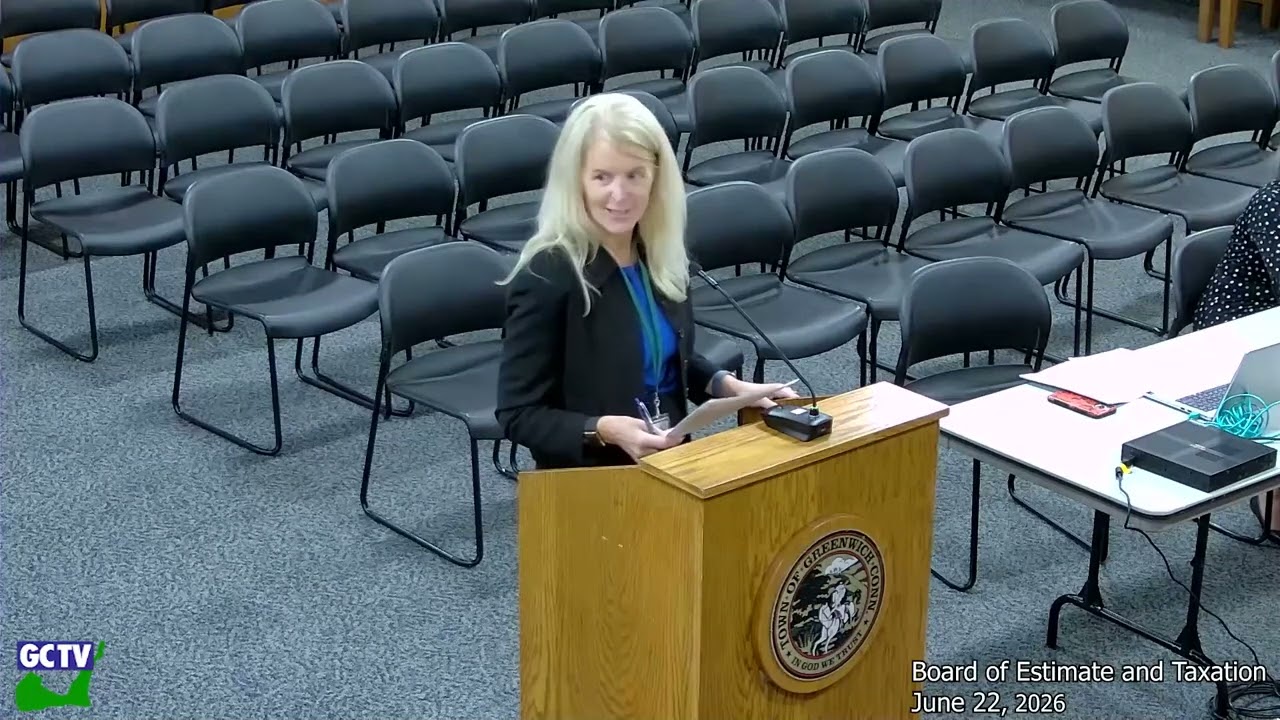
Other Committee · Meeting of June 22, 2026
Greenwich BET creates standing debt policy committee, advances pay study. The Board of Estimate and Taxation voted unanimously to establish a Debt and Fund Balance Policy Committee, with member Olchyk saying the underlying group already voted 4-0-0 to recommend it after concluding there is "a problem in the outer years." Assessor Elliott reported 98 tax appeals covering more than $2 billion in disputed value, with the town facing calls mostly about prorated motor vehicle taxes so far: "so far so good," she said. Controller Joan Lynch, closing her first year in the role, reported a $757.3 million retirement portfolio and $31 million spent of the town's $31.4 million ARPA allocation, with a December 31 deadline looming.
The board also gave second-read approval to a reorganized BET reference manual and advanced, without yet funding, a compensation study known as the MNC study.
In the full story:
- Who Was There
- Organizations And Documents Referenced
- The complete report — 3,330 words
Source: the Other Committee meeting of June 22, 2026, reported from the official video recording and transcript.
The Full Article
Assessor's Report
Background and stakes: Property tax bills went out June 17, and the assessor's office fields the bulk of the resulting call volume in the days after. The report also covers senior tax-credit turnover and the annual tax-appeal cycle, both routine but consequential line items for the grand list.
The question before the body: Whether to accept the assessor's June report as presented.
Substantive content: Assessor Elliott told the board most calls concerned motor vehicle taxes rather than real estate, since the town prorates vehicle taxes for residents who no longer own the car being billed; of roughly 52,000 total tax bills, a large share are for motor vehicles. On senior tax credits, Elliott said 61 recipients from the 2024 grand list did not reappear on the 2025 list: 16 sold their homes, 14 died, 12 were determined over the income threshold, and 19 simply did not reapply and are presumed over income as well. The town gained 33 new applicants, and the net effect pushed total credits from $742,000 to $690,000. On tax appeals, Elliott said 98 were filed by the May 27 deadline: 30 residential (12 of them repeat filers) and 68 commercial (41 repeat filers), together covering more than $2 billion in disputed fair market value. She said the firm identified in the meeting as Zeilburger and Shoenberg will represent the town in 96 of those cases, while attorney Adam Blank of the firm Wilson Rosen will handle two cases where a conflict of interest arose.
The deliberation: Member Leslie Tarkington used her turn to note, apart from the appeals discussion, that Elliott had taught the revaluation course at the University of Connecticut earlier in the month and been invited back for another five years, calling it recognition of her work. When Chairman David Weissbrodt pressed Elliott for her assessment of the town's exposure in the pending appeals, Elliott began to answer before the chairman cut in.
"I'd be really careful about commenting on pending litigation." — Chairman David Weissbrodt
Elliott agreed to take the question offline rather than discuss active cases in open session.
Procedural steps and outcome: Tarkington moved to accept the assessor's report; the motion was seconded, and the board approved it unanimously by voice vote.
Implications and what is next: With $2 billion in appeals in play, the outcome of the pending litigation will affect the town's grand list and tax revenue, though specifics remain confidential while cases are active.
Executive Session
The board entered executive session at 6:38 p.m. on a motion by Erickson, seconded by Pellegrino, and returned to open session at 6:52 p.m. on a motion by Erickson, seconded by Deschamps. No substance from the closed-door discussion was disclosed in open session; the board's regular secretary was absent from the meeting, and Chairman Weissbrodt said he would act as secretary with help from staff.
Routine and Non-Routine Budget Applications
Background and stakes: Item four covered four routine budget adjustment requests; item five covered a set of non-routine capital carry-forward appropriations that the Budget Committee had already reviewed as a single package.
The question before the body: Whether to approve the routine adjustments and the non-routine carry-forwards as presented.
Substantive content: The routine item included $240,000, $110,000 for Greenwich Library, $28,286.32 for the Conservation Commission, and $50,000 for public works, totaling $428,286.32. The non-routine item was an omnibus set of capital carry-forward appropriations beginning with $209,000 for the Bruce Museum and continuing through $600,000 for the Town Hall parking garage rehabilitation; one additional non-routine item on the agenda was deferred to the next meeting.
The deliberation: Both items moved without debate. A member noted that the Budget Committee had "treated this as an omnibus motion," meaning the individual carry-forward lines were not read individually into the record.
Procedural steps and outcome: Item four was moved by Erickson, seconded by Pellegrino, and approved unanimously. Item five was moved by Erickson, seconded by Pellegrino, and approved unanimously with no opposition.
Implications and what is next: The carry-forwards let previously appropriated capital dollars remain available for projects, including the garage rehabilitation, without lapsing at fiscal year-end.
Controller's Report
Background and stakes: This was Controller Joan Lynch's final controller's report of fiscal year 2026, marking the close of her first 12 months in the role, delivered as the finance department prepares its year-end closing calendar ahead of June 30 financial statements.
The question before the body: Whether to accept the controller's report covering May 19 through June 22.
Substantive content: Lynch reported the town's retirement portfolio gained 1.6 percent in May, was up 14 percent on a rolling one-year basis, and up 11.11 percent fiscal year to date, with total composite market value of $757.3 million, up from $748.8 million the prior month. The OPEB trust portfolio stood at $68.4 million as of May 31, up $2.3 million, or 3.56 percent, from $66 million on April 30, with a 20.69 percent gain over the trailing 12 months. On the American Rescue Plan Act, Lynch said the town's ARPA cash balance was $5.16 million as of May 31, nearly $1 million of which is interest, and that as of June 17 the town had spent or encumbered $31 million of its original $31.4 million allocation. Of the remaining $3.4 million tied to sewer projects, $1.7 million is being transferred from the Grass Island project to the Cos Cob pump station project within the same infrastructure category, a shift Lynch said is allowed under ARPA guidelines and intended to fully use the funds before the December 31, 2026 federal deadline. She also reported that at its June 18 meeting, the Audit Committee reviewed and accepted the fiscal year 2026 audit plan from external auditor RSM US LLP, with preliminary fieldwork already underway. On departmental initiatives, Lynch described a new platform called Arbiter Pay, which automates payments to game officials and event workers to reduce reliance on mailed paper checks, some of which she said have been stolen from the mail; the Board of Education will begin using it this fall. She also introduced Dan Morantz, a newly hired accounts-payable coordinator with a background in artificial intelligence, who is leading a standardization initiative to document standard operating procedures across finance department functions.
The deliberation: A member asked whether the roughly $1 million in ARPA interest is also subject to the December 31 spend-down deadline. Lynch said no, that the interest is budgeted in fiscal 2026 and will instead be transferred into the general fund. Member Selbst praised the Arbiter Pay initiative directly.
"Every single thing that your department does to minimize the use of snail mail and checks is really a step into the 21st century." — Member Selbst
Lynch responded that electronic payment adoption remains uneven among vendors, noting that new vendors are generally required to accept ACH payment but that some, particularly large multi-account vendors, continue to resist.
Procedural steps and outcome: Tarkington moved to accept the controller's report, seconded by Selbst; approved unanimously.
Implications and what is next: The ARPA reallocation and spend-down pace keep the town on track to fully use its federal award before the deadline; the standardization initiative and ACH push are ongoing, multi-year departmental projects with more updates expected.
Treasurer's Report
The treasurer, not otherwise named in the meeting, reported the town's general fund invested cash position reached $147.5 million as of May 31, approximately $8.2 million higher than April 30. Interest earned on general fund bank deposits and investments in May was $420,000, reflecting a 3.83 percent blended annualized rate, with fiscal year-to-date interest earnings of $7.4 million against a budgeted $7 million. No questions followed. Olchyk moved to accept the report, seconded by Tarkington; approved unanimously.
CMS Building Project Update
Background and stakes: The board's special-projects liaison provides regular updates on the CMS building project as substantial completion approaches ahead of the coming school year.
The question before the body: An informational update rather than a vote.
Substantive content: Member Fisher said the project remains on target for substantial completion of the new building on August 4, with a temporary fire pump system, consisting of two tanks, a fire pump and a generator, being installed adjacent to where the sprinkler and water lines enter the building. He said the project has informal sign-off from the building department, the fire marshal and the state, and that the district is targeting an August 21 date for teachers to access the building ahead of the school year, giving them roughly a week to 10 days of preparation time. Fisher credited John Bowery, the chief building officer, and Mark Dawson, the fire marshal, for devoting significant hours to the project.
"Everything's rocking along." — Member Fisher
Chairman Weissbrodt asked Fisher to provide another update at the July BET meeting, just before the scheduled building opening; Fisher agreed.
Implications and what is next: A follow-up update is expected at the July BET meeting, with the district's access date of August 21 serving as the next concrete milestone.
New Business: OPEB Trust Board Reappointments
Background and stakes: The OPEB (Other Post-Employment Benefits) Trust Board has three members whose terms come up for renewal, including one BET representative.
The question before the body: Whether to reappoint the current OPEB Trust Board membership.
Substantive content: Member Olchyk said outside member Rob Harteveldt will continue in his role alongside Sally Bednar, with Olchyk continuing as the third, BET-appointed member. Olchyk noted the portfolio's performance over the last year exceeded 20.5 percent but said the board is pushing for continued improvement in both process and returns, with changes coming to how the portfolio is managed.
The deliberation: Member Pellegrino praised the appointees.
"I think we, the BET, the town are well served by the appointment of both Ms. Bednar and Rob." — Member Pellegrino
Procedural steps and outcome: Selbst moved to accept the reappointments, seconded by Fisher; approved unanimously.
Implications and what is next: The reappointed board will continue overseeing the roughly $68.4 million OPEB trust portfolio, with anticipated changes to investment management approach still to come.
New Business: Debt and Fund Balance Policy Committee
Background and stakes: This item formalized what had been an ad hoc committee's work into a permanent standing committee, following what Olchyk described as an emerging consensus that the town faces financial pressure in future budget years.
The question before the body: Whether to establish the Debt and Fund Balance Policy Committee as a standing BET committee.
Substantive content: Olchyk read the committee's stated purpose: to conduct ongoing review of the town's long-term capital plan, ensure capital projects under consideration are properly included and reasonably estimated, evaluate financing scenarios including debt maturities, timing of debt issuance and recommended capital tax levy, and review and recommend updates to the town's debt and fund balance policy.
The deliberation: Olchyk said the underlying committee voted 4-0-0 to recommend the change and detailed the group's work to date.
"We've identified capital projects, we've vetted them, we've closed out open capital ... and as my colleague Mr. Pellegrino pointed out at our last committee meeting, they've accepted that there is a problem in the outer years and that we need to do something about it." — Member Olchyk
Olchyk credited Joan Lynch and a staff member referred to as Agnes for closing out open capital items, and said the committee had taken input from town departments and the Representative Town Meeting, along with sensitivity analyses on the capital tax levy and term of debt.
Procedural steps and outcome: Olchyk moved to establish the committee, seconded by Selbst; approved unanimously with no further discussion.
Implications and what is next: The new standing committee gives Greenwich a dedicated body for long-range capital and debt planning; its recommendations will feed into future BET decisions on debt issuance and the capital tax levy.
New Business: MNC Study
Background and stakes: The item, under the jurisdiction of the Human Resources Committee chaired by Olchyk, concerns a study referred to in the meeting as the "MNC study." A memo on the topic was circulated to members ahead of the meeting.
The question before the body: Whether to advance the process of moving the MNC study forward, including forming a committee, without yet appropriating funds.
Substantive content: Olchyk said the board is not yet voting on funding but on moving the process forward, including forming the committee that will oversee it; a future appropriation vote will follow once cost information from a request-for-proposals process is available. Olchyk credited progress on the study to two people referred to only as Josh and Doug, with additional input from Tarkington.
The deliberation: Erickson voiced support but flagged the financing step still to come.
"I'm fully supportive of this. I think this is something we need to do ... it's my understanding that an appropriation is still required once you get the RFPs back and make a decision. So, this will come back to us at that point." — Member Erickson
Member Selbst noted the issue had been on the Human Resources Committee's agenda when he served on it "two terms ago," calling the progress overdue.
Procedural steps and outcome: Olchyk moved to advance the process, seconded by Tarkington; approved unanimously.
Implications and what is next: The board will need to take a separate appropriation vote once RFP responses and cost estimates are in hand; no timeline for that vote was given.
BET Reference Manual, Second Read
Background and stakes: The BET's internal reference manual, an aging document maintained in Word, has been under review by a subcommittee that took input from town committees over two working sessions. The first read occurred at the previous month's meeting.
The question before the body: Whether to approve the reorganized, redlined second-read version of the manual, understanding a clean version will return for further review.
Substantive content: Member Erickson, presenting with colleague Josh Brown absent, said the rewrite removes membership profiles from the manual entirely, placing them in a separate, more easily updated document. The existing section one, covering the BET's organization and meeting procedures and currently beginning on page 18, moves to the front of the manual, with charter and Connecticut General Statute references pushed to sections two and three. The new section one also codifies policies, processes and procedures by assigned committee, with each committee asked to review its assigned policies once per term; Erickson noted the Human Resources Committee currently has no policies assigned to it, which the board may want to address. Section two remains largely unchanged except for new language reflecting the OPEB program's outsourced investment manager, a change Erickson said occurred at least five years ago. Section three replaces the manual's prior appendix of charter-related items for future consideration; Erickson said the committee has not taken up charter revision itself. She noted the reorganization inadvertently omitted the Old Greenwich Building Committee from the special-projects list and lacks finalized language for the new Debt and Fund Balance Policy Committee's charge, both to be added in a future round.
The deliberation: Erickson thanked Joan Lynch, the town attorney, Tarkington, former BET chair Mike Mason and David Weissbrodt for attending input sessions, and singled out staff member Leo for reorganizing the document. She acknowledged the version under consideration remains difficult to read because of extensive redlining.
"I would respectfully make a motion to approve this version of the BET reference manual, with the understanding that there's still some things to come." — Member Erickson
A member seconding the motion referred to it as "Laura Smith's motion," a discrepancy with Erickson's consistent identification throughout the meeting; see the review note below. Discussion followed about outstanding items, including whether the Investment Advisory Committee's policy language still references the "retirement board" incorrectly, and whether the Audit Committee should develop a risk fund policy in a future round. One member asked for assurance a final, non-color-coded document would return for review; Erickson confirmed the accepted redline changes would appear clean at the next read, aside from any newly proposed edits. Member Kelly departed mid-discussion, citing a leaking roof at home, prompting good-natured jokes from colleagues as the vote was called.
Procedural steps and outcome: Tarkington seconded the motion for final approval. The board voted to approve the second-read version unanimously by voice vote, with the understanding that a clean copy incorporating the Old Greenwich Building Committee addition and the new committee's charter language will return, ideally with Brown present, at the next meeting.
Implications and what is next: A finalized, non-redlined version of the reference manual is expected to return to the board, likely at the July meeting, for what members described as a final vote.
Minutes and Chair's Report
The board approved its prior meeting minutes unanimously on a motion by Olchyk, seconded by Tarkington. Chairman Weissbrodt then gave two announcements: a Zoom presentation on ethics-board "safe harbors" by Mr. DeBerry of the ethics board was scheduled for Wednesday at 3 p.m., with a recording to be made available for members unable to attend live; and a reminder that members who have not completed required cyber-security training should do so to avoid having their town email suspended, noting he had recently completed his own. The board adjourned at 7:29 p.m. on a motion by Fisher, seconded by Bednar.
Chairman David Weissbrodt, presiding. Member Leslie Tarkington. Member Pellegrino. Member Erickson. Member Selbst. Member Olchyk, chair of the Human Resources Committee. Member Fisher. Member Deschamps. Member Kelly, departed before the meeting's final vote due to a home plumbing emergency but was present for the vote itself. Member Josh Brown, absent; his absence was noted by the chair and by Erickson. The board's regular secretary, absent; role not filled by name. Town Assessor Elliott, presented the assessor's report. Controller Joan Lynch, presented the controller's report. The town treasurer, presented the treasurer's report; not named in the meeting. Staff members Agnes and Leo assisted with meeting administration and document production. AP Coordinator Dan Morantz, referenced by Lynch as a new hire; not confirmed present.
No public commenters were identified speaking in the meeting.
Outside parties referenced but not present: attorney Adam Blank of Wilson Rosen (tax appeal representation); the firm identified as Zeilburger and Shoenberg (tax appeal representation); RSM US LLP (external auditor); Rob Harteveldt (outside OPEB Trust Board member); Sally Bednar (OPEB Trust Board member); Mike Mason, former BET chair (attended reference-manual input sessions); Mr. DeBerry of the ethics board (upcoming Zoom presenter).
RSM US LLP — external auditor whose fiscal year 2026 audit plan was reviewed and accepted by the Audit Committee on June 18. The law firm identified in the meeting as Zeilburger and Shoenberg — representing the town in 96 of 98 pending tax appeals. Wilson Rosen — law firm whose attorney Adam Blank represents the town in two tax appeal cases involving a conflict of interest. Arbiter Pay — payment automation platform adopted by the finance department and, starting this fall, the Board of Education, to reduce mailed paper checks to game officials and event workers. American Rescue Plan Act (ARPA) — federal program under which the town must fully spend or return its $31.4 million allocation by December 31, 2026; discussed in the controller's report. Grass Island project and Cos Cob pump station project — sewer infrastructure projects between which $1.7 million in ARPA funds is being reallocated. Representative Town Meeting (RTM) — town legislative body whose input was incorporated into the Debt and Fund Balance Policy Committee's work. BET Reference Manual — the board's internal governance document, undergoing a second-read reorganization. OPEB Trust Board — oversees the town's roughly $68.4 million Other Post-Employment Benefits trust; subject of Monday's reappointment vote. The MNC study — a Human Resources Committee-led review process invoked in the new-business discussion; its full scope was not defined in the meeting. Bruce Museum, Greenwich Library, Conservation Commission, and the Town Hall parking garage — beneficiaries of the routine and non-routine budget items approved Monday.