

Greenwich budget panel splits 2-0 on new guidelines document
Other Committee · Meeting of July 14, 2026
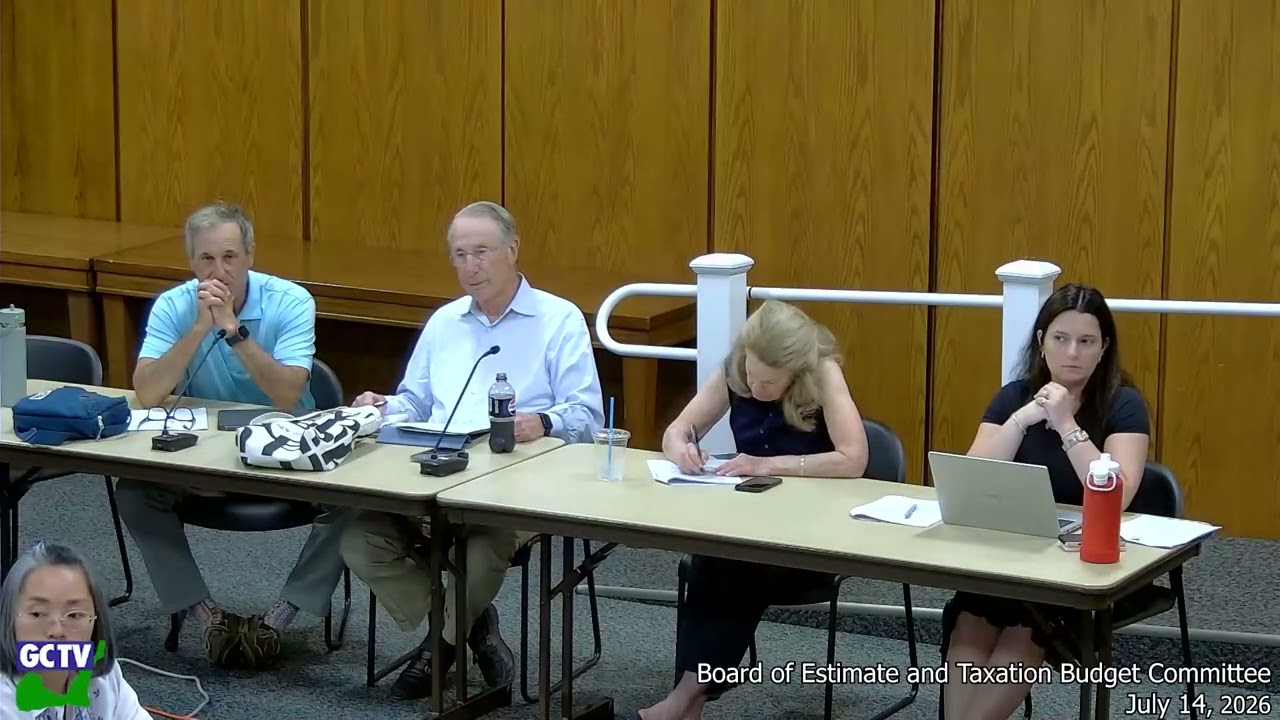
Greenwich BET Budget Committee splits 2-0 on new budget strategy guidelines. The panel voted 4-0 to approve $20,050 in Friends of Nathaniel Witherell donations for the rehab facility's Therapeutic Recreation Department, including $14,475 for personal services tied to expanding its evening music program. Budget Committee Chair Laura and member Doug Fenton, who co-authored a new "budget strategy guidelines" framework aimed at fiscal 2028 department budgets, prevailed 2-0 with two abstentions after members Harry Fisher and Joe Kelly objected to how the document was drafted rather than its content.
"The document was presented to us. That's not collaboration," Fisher said. Fenton countered that "there's no partisan ownership of good ideas." The committee also accepted a report on $350,000 in combined town and Friends-of-the-Wallace-Center funding for a senior center renovation, and heard word of a small preliminary fiscal 2026 town budget surplus.
In the full story:
- Who Was There
- Organizations And Documents Referenced
- The complete report — 2,497 words
Source: the Other Committee meeting of July 14, 2026, reported from the official video recording and transcript.
The Full Article
Executive Session on a Legal Matter
The meeting opened at 1:11 p.m. with a motion from committee member Harry Fisher to enter executive session "for discussion of a legal matter," seconded and approved by unanimous voice vote. The committee returned at 1:24 p.m., a little over 13 minutes later. Chair Laura told members "we are not planning to take any votes on what was discussed in executive session," and the substance of the legal matter was not identified on the record.
Nathaniel Witherell Funding Request (NW1)
Background and stakes: Under the town's fiscal 2027 budget resolution, private donations to Nathaniel Witherell, the town-owned rehabilitation and long-term care facility, must be approved by the Board of Estimate and Taxation before the town controller can appropriate them.
The question before the body: Whether to approve use of a $20,050 donation from the Friends of Nathaniel Witherell for specific recreation and department expenses.
Substantive content: Fisher moved approval of item NW1, seconded by Fenton. Joan, a town budget staffer who presented the item, explained that the Friends of Nathaniel Witherell are making two roughly equal payments this fiscal year, and that this first payment of $20,050 arrived that day. She said the funds would go to the Nathaniel Witherell Therapeutic Recreation Department in three categories: $14,475 for miscellaneous personal services, described as primarily supporting the expansion of an evening music program; $3,800 for food; and $1,775 for office services. In response to a member's question, Joan clarified the food and office-services categories cover picnics and special events, not routine operating costs. A member joked about "bird food," prompting laughter, with Joan noting "there is a detail in the packet."
The deliberation: The only substantive question was procedural — whether the funds fell under fiscal 2026 or the current cycle. Joan clarified the check had arrived that day and that the Friends had agreed to split their annual gift into two payments, in July and presumably January, for administrative simplicity.
Procedural steps and outcome: The item passed 4-0 on a voice vote. Chair Laura noted, "I assume we can recommend this as a routine item," and Joan confirmed it was.
Implications and what is next: A second, similar Friends of Nathaniel Witherell payment is expected around January 2027.
Commission on Aging: Wallace Center Renovation Report
Background and stakes: A prior budget resolution requires an annual report to the committee on funds the town receives from the Friends of the Wallace Center toward a senior-center renovation project that has been underway "a couple of years," according to Joan.
The question before the body: Whether to accept the annual report on Wallace Center renovation funding for fiscal 2026.
Substantive content: Joan told the committee the total architecture-and-engineering renovation budget is $350,000. That figure is built from a Connecticut Department of Aging and Disabilities ARPA allocation, a separate $146,035 town ARPA allocation that has been fully spent and received, and $203,965 in private funds pledged by the Friends of the Wallace Center. Of that private pledge, $38,000 represents the first allocation received under the current appropriation, with the Friends reimbursing the town quarterly for invoiced project costs; the payment covered in this report was received June 30, 2026, the close of fiscal 2026.
The deliberation: Chair Laura asked how the committee should handle the recurring, quarterly nature of the Friends' reimbursements going forward, since Wallace Center will not be the only source of such payments. "I think we should only do it once a year is what I'm respectfully requesting," she said. Joan agreed a single annual appropriation cycle made sense, since "the funds have already been appropriated" and the quarterly Friends payments are simply refilling money already authorized. A member asked whether holding the funds created a lag problem; Joan said no, because no new appropriation action is required — the committee is only accepting the report, not re-authorizing spending.
Procedural steps and outcome: Members voted to accept the report by voice vote, with no objection recorded. No additional appropriation vote was needed.
Implications and what is next: Future Wallace Center and other Friends-funded reimbursements will be batched for an annual committee report rather than reviewed quarterly, under the approach discussed Tuesday.
New Business: The Budget Strategy Guidelines Document
Background and stakes: Chair Laura told the committee the document grew out of "takeaways" from the fiscal 2027 budget cycle just completed, and was circulated to all members on June 30 for feedback, with one round of revisions already incorporated. It is intended as an early, general framework — distinct from the more detailed budget guidelines document the committee produces later in the calendar — meant to give departments, the Board of Education and appointing authorities advance notice of priorities before they build fiscal 2028 budgets.
The question before the body: Whether to adopt the strategy guidelines document as drafted, and to whom it should be circulated.
Substantive content: The document's three sections, as described by Chair Laura, ask departments and the Board of Education to: first, undertake "metrics-driven personnel investment and optimization," defining objectives, reviewing staffing models against those objectives, identifying organizational silos and cross-training opportunities, and comparing overtime use to headcount, flagged as important well ahead of collective bargaining negotiations given long lead times; second, review revenues and fees not recently reassessed, a theme Chair Laura said Fenton had raised repeatedly during the last budget cycle; and third, pursue "targeted investments," including a position — originally proposed as a dedicated energy manager, revised after committee feedback to allow an outside consultant as an alternative — to address rising utility costs, plus technology and artificial-intelligence investment. On the AI point, Chair Laura cited the BET Law Committee's plan to request an expanded, AI-enabled tier of the Westlaw legal research service next budget cycle as "a perfect example of paying more for functionality that ultimately will improve efficiency."
The deliberation: Fisher raised two objections. First, he argued the document should not go directly to department heads but instead be circulated by the first selectman, the Board of Education and appointing authorities to their own staff, with those managers responsible for gathering feedback. "This is a management-oriented memo," he said, distinguishing it from the traditional budget guidelines document. Chair Laura disagreed: "I think it is appropriate for this body to send this document without a filter to department heads," noting BET members already serve as liaisons to town departments. Fisher's second objection was that the document's AI-related section should more explicitly direct departments to coordinate through the town's AI committee, which he said has liaisons from most departments, rather than let "each department out thinking, 'Well, I'll go this way or I'll go that way.'"
Kelly and Pellegrino raised a separate, process-focused objection. Kelly said other BET committees, including the one producing this same document historically, involve two representatives from each political caucus in drafting, so that "the document's origin comes from a team effort" reached by consensus rather than being presented by one side. "It just kind of came to our caucus, and our caucus found ourselves kind of spinning in conversation," he said. Pellegrino agreed with the substance of the document but suggested, as an improvement, that the committee hold a public working session — citing a similar session held by the Capital and Debt/Fund Balance Policy Committee that drew limited public attendance but "allowed us to free flow with ideas."
Fenton pushed back on the characterization that the document lacked collaboration, saying its ideas came from conversations across party lines dating to when members were sworn in, plus input solicited from the first selectman's office and across town departments. "There's no partisan ownership of good ideas," he said. He credited Fisher specifically with having long championed non-tax revenue and fee review. Chair Laura added that "someone has to take the initiative" to draft such documents, noting that past budget guidelines were traditionally drafted by the budget committee chair, with Fenton taking the lead this time, sharing it with her, and both sharing it with their respective caucuses for comment before wider circulation. Fisher maintained the distinction was about consultation, not outcome: "Nobody on your side came to us and said, 'We're thinking of doing this. What would you like to see in it?' The document was presented to us. That's not collaboration."
Chair Laura declined Pellegrino's suggestion to make the document more specific to individual departments, saying it was "deliberately posed to be general" so as not to single out any one department, and that specifics would come in the September budget guidelines document instead. She also cautioned against Pellegrino's framing of inter-department "competition," saying every department is different and the committee should avoid treating them identically, citing ongoing Board of Education staffing, enrollment and special-education cost pressures, and noting Nathaniel Witherell is expected to update the full BET on census challenges at its regular meeting Monday, July 20.
Procedural steps and outcome: The document passed 2-0 with two abstentions. Fisher and Kelly abstained, both stating they had no objection to the document's content but wanted a more collaborative drafting process going forward; neither voted against it. Fenton and Pellegrino voted in favor. No amendments were offered from the floor before the vote.
Implications and what is next: The committee's more detailed budget guidelines document — the traditional, department-specific counterpart to Tuesday's framework — is expected to come before the committee for a first read in September, with adoption targeted for October and a working draft due before Labor Day, according to Chair Laura.
Housekeeping: Committee Reference Manual
The committee briefly revisited a standing reference manual documenting committee procedures, which Fenton said had a scrivener's error and an outstanding question about whether Regional Town Meeting committee and district meetings occur only in March or also in April and May. Chair Laura said the manual would be updated to note that RTM committee and district meetings can occur across March, April and May, and that whether a given committee is drawn into budget discussion during those months can vary — citing Health and Human Services as an example of a committee that sometimes takes up budget matters early. Pellegrino praised the ongoing cleanup of the document, and Chair Laura credited staff member Leo with the underlying work: "This is the beast. So, just rearranging it and redlining it and keeping track of everything, it really is an outstanding job. Well done, Leo." No vote was required.
Minutes and Chair's Report
Fenton moved approval of the June 16 Budget Committee minutes, seconded, and approved by voice vote with no recorded objection. In her chair's report, Laura said she had already met with Joan and staff member Agnes on the fiscal 2028 budget guidelines document, with Agnes preparing supporting exhibits. She confirmed the plan for a September first read and an October approval target, saying a working draft exists but "may be some holes" and "may be some gaps."
Fiscal 2026 Preliminary Surplus
Joan closed the meeting with an update on preliminary fiscal 2026 results, describing "a small surplus." She said revenues came in slightly higher than the town's conservative estimates, but the larger factor was expenses coming in lower than expected, driven partly by reduced year-end encumbrances. She credited Agnes and the committee's prior directive for improved accuracy in how departments track encumbrances against real contractual obligations, calling it "positive behavioral changes," while cautioning the shift could reduce next year's typical reversal of unused encumbrance funds. The meeting adjourned at 2:01 p.m., with Chair Laura wishing member Don Conway a good August recess.
Chair Laura — presided over the meeting, called votes, gave the chair's report; surname not stated in the available transcript.
Harry Fisher — committee member; moved the executive session motion and the Nathaniel Witherell funding motion; abstained on the budget strategy guidelines vote.
Doug Fenton — committee member; seconded the Nathaniel Witherell motion and the minutes approval; co-authored and moved adoption of the budget strategy guidelines document.
Joe Kelly — committee member, addressed as "Mr. Kelly" and "Joe"; abstained on the budget strategy guidelines vote.
Pellegrino — committee member, addressed as "Mr. Pellegrino"; first name not stated in the available transcript; voted in favor of the budget strategy guidelines document.
Natasha — referenced once by the chair during the guidelines debate ("All right, Natasha" / "Yeah, go ahead"), deferring the floor to Fenton; role and surname not established in the available transcript.
Don Conway — addressed by the chair at adjournment; role not otherwise described in the available transcript.
Joan — town budget staffer; presented the Nathaniel Witherell (NW1) and Wallace Center funding items and the fiscal 2026 preliminary surplus update; surname and formal title not stated.
Agnes — town staffer; preparing exhibits for the fiscal 2028 budget guidelines document; credited with encumbrance-accuracy directive follow-through; surname and formal title not stated.
Josh — town staffer; referenced regarding RTM committee/district meeting scheduling and the reference manual; surname and formal title not stated.
Leo — town staffer; credited by the chair for building and maintaining the committee reference manual; surname and formal title not stated.
Friends of Nathaniel Witherell — nonprofit support organization; source of the $20,050 (and a second, similar) donation approved as item NW1.
Friends of the Wallace Center — nonprofit support organization; pledged $203,965 in private funding toward the Wallace Center renovation project, of which $38,000 has been allocated and is reimbursed to the town quarterly.
Connecticut Department of Aging and Disabilities — state agency; source of an ARPA allocation cited as part of the Wallace Center renovation project's funding.
Board of Estimate and Taxation (full BET) — the Budget Committee's parent body; the guidelines document was described as feeding discussions BET liaisons will have with departments, and Nathaniel Witherell is expected to brief the full BET on census challenges Monday, July 20.
BET Law Committee — cited by Chair Laura as planning to request an expanded, AI-enabled Westlaw subscription in the next budget cycle, offered as an example of the "targeted investments" section of the new guidelines document.
BET Audit Committee — cited as conducting an inventory of town software subscriptions and other technology-related leases, relevant to the guidelines document's technology section.
Town AI Committee — cited by Fisher as a body with cross-department liaisons that he argued should have a stronger formal role in the guidelines document's AI-related requests.
Capital and Debt/Fund Balance Policy Committee — cited by Pellegrino as a model for a public working-session approach to drafting collaborative documents.
Budget strategy guidelines document — new framework document, adopted 2-0 with two abstentions, previewing fiscal 2028 budget priorities for departments, the Board of Education and appointing authorities ahead of a more detailed budget guidelines document expected in September.
Fiscal 2027 budget resolution — cited as the authority requiring BET approval of private donations, such as the Nathaniel Witherell funds, before town appropriation.
June 16 Budget Committee minutes — approved by voice vote at Tuesday's meeting.