BET Rejects 3% Budget Cap in Tie Vote
Greenwich's Board of Estimate and Taxation deadlocked 6-6 on a hard 3 percent operating-budget cap before unanimously adopting softer fiscal 2028 budget guidelines.
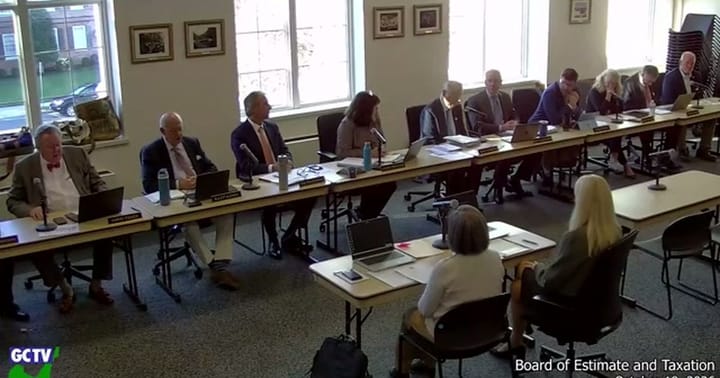
Other Committee · Meeting of October 19, 2026
Greenwich's Board of Estimate and Taxation deadlocked 6-6 on a hard 3 percent operating-budget cap before unanimously adopting softer fiscal 2028 budget guidelines. Member Joe Pellegrino's proposal, which he said would require roughly $1.6 million in added savings against a $364 million budget, failed on the tie; Budget Committee member Doug Fenton argued it would undercut a shift toward "structural change" rather than incremental budgeting. The board then approved a substitute amendment citing 4.5 percent CPI-U inflation and setting a 3.5 percent mill-rate target, 12-0, and adopted the full guidelines unanimously.
Controller Joan Lynch reported Nathaniel Witherell nursing home lost $4 million last year and carries a $7.7 million negative fund balance. The finance department also detailed digitization projects, including a JP Morgan payment partnership projected to cut vendor costs 40 percent and an accounts-payable automation rollout covering over 50,000 invoices annually.
In the full story:
- Who Was There
- Organizations And Documents Referenced
- The complete report — 2,522 words
Source: the Other Committee meeting of October 19, 2026, reported from the official video recording and transcript.
The Full Article
Opening Business and Commemorations
The meeting opened with a moment of silence for John Marganow, described as a former first selectman who served the town for roughly six decades, including ten years on the Representative Town Meeting starting in 1959 and a term as first selectman from 1979 to 1981. The chair also marked a birthday for a finance department staff member referred to only as Leo. Because the regular town hall meeting room was in use for early voting, the board met in a different room and was told it had to vacate by 6 p.m.
Assessor's Report
With the assessor out ill, the board accepted the written assessor's report, submitted by Assessor Elliot, without discussion. Member Leslie Tarkington moved acceptance; the vote passed unanimously, 12-0-0.
Controller's Report
Controller Joan Lynch reported that external auditor RSM is in the field through early November with what she called "excellent collaboration" across departments and the Board of Education. Internal auditor CLA has delivered its IT assessment to the audit committee, with "many follow-ups" being tracked, and is beginning a golf-course audit at Griffith E. Harris and a school lunch program review, alongside unrelated procedures involving a food-service contractor Lynch referred to as Mets Culinary Management. On federal pandemic-relief compliance, Lynch said the town has spent or encumbered $31.3 million of its $31.4 million ARPA appropriation, with the Health Department holding $63,000 for a public health educator position as the only unspent, unencumbered balance; a required U.S. Treasury quarterly report is due October 31.
Lynch also flagged a collective bargaining contract with Firefighters Local 1042 running through June 2029, scheduled for Representative Town Meeting review on October 26. On pensions, a new retirement valuation report put the town's actuarially determined employer contribution at $21,525,234, down from a previously budgeted $22.3 million but slightly above a July estimate of $21.4 million. The actuarial accrued liability stands at $791.5 million against $716 million in actuarial assets, for a 90.5 percent funded ratio and a $75 million unfunded liability; using the September 30 portfolio market value of $756 million instead would put the funded ratio closer to 95 percent, Lynch said. She separately reported that the old Central Middle School building was removed from the town's property insurance inventory following its October 16 foundation demolition.
Finance Department Modernization Initiatives
The question before the board: whether to endorse, informally, a slate of five technology projects the finance department is pursuing to reduce paper-based processing. Finance Accounting Manager Caroline Fay, who joined the town two and a half years ago, and AP Coordinator Dan Murray, who started in May, walked members through each.
The first, a "strategic payables" partnership with JP Morgan, would route some vendor payments through the bank's network, offering the town rebates on premium ACH and virtual-card payments. Murray said vendors already onboarded to JP Morgan's network represent "about a 40 percent reduction in dollars in spend" and a 12 percent reduction in the number of payments the town issues, with enrolled-vendor savings ramping to $300,000 annually. The project is on hold pending technical integration between JP Morgan and the town's Tyler enterprise system; Fay said both vendors had previously committed to earlier timelines that were not met, and the town is now targeting calendar Q1 2027 to go live. Member Steven Selbst pressed on accountability for the delay: "They are accepting responsibility. But that remains to be seen for sure," Lynch said.
Second, a self-service reporting tool (SSRS) has produced twelve live reports that previously required manual data extraction into Excel. Third, an e-procurement consolidation has moved all town purchasing onto a single Amazon account; Selbst asked how much business that represents, and Murray estimated roughly $800,000 annually, including Board of Education purchases, while Fay said consolidating accounts let the town negotiate free Amazon Prime access town-wide, previously paid for separately by departments. In response to a follow-up from member Steven Selbst about whether Amazon pricing is actually compared against competitors, Fay said departments that order goods are responsible for comparison shopping; the finance department, which only processes payment, will gain new back-end visibility through SSRS to support that analysis. WB Mason was named as the next vendor targeted for similar integration.
Fourth, an accounts-payable automation project, built on a Tyler software module, would digitize the roughly 50,000-plus invoices the town processes annually, replacing manual data entry and paper signatures with a digital approval record. The recurring cost is $42,000 annually, not currently absorbed in the finance department's budget. Murray said Tyler is only now exiting a pilot phase with a small number of other Connecticut towns. Fifth, a role-based access control project would simplify roughly 300 active system-user roles to reduce the risk of segregation-of-duties violations.
Members Selbst, David Weisbrot, Doug Fenton and Josh Brown all spoke favorably. Selbst asked whether efficiencies could eventually translate into headcount reductions; Fay said the department is "not there yet" on quantifying that, noting purchasing staff are spread across town and school buildings and any change requires broad buy-in. Fenton connected the presentation directly to the budget guidelines debate to follow, calling it a model for "potentially other departments" to show upfront investment that lowers long-term costs or reduces risk. Selbst said: "I have to tell you, in the five years I've been on this board, this is actually, from a system standpoint, the most exciting thing I've heard."
No formal vote was taken on the modernization projects; the discussion was informational, with the chair noting that tracking multi-year returns on these investments "is going to be a big challenge" the board intends to monitor going forward.
Treasurer's Report
Lynch reported invested general fund cash of $239.7 million as of September 30, up $3.5 million year over year, with September yield of 3.81 percent blended annualized and fiscal-year-to-date interest earnings of $1.7 million. The general fund holds $100 million face value in U.S. Treasury notes yielding between 3.51 and 4.08 percent; a winding-down CD program holds $2.3 million at a 4.55 percent average yield. The Connecticut STIF rate rose to 3.96 percent as of October 13. The retirement trust portfolio's market value fell to $756.2 million as of September 30, from $769.5 million in August, posting a negative 1.28 percent monthly and negative 0.99 percent quarterly return, though both periods outperformed policy benchmarks; rolling 12-month return was 9.57 percent. The OPEB trust closed September at $67.1 million, down $1.2 million for the month, with a 9.71 percent trailing 12-month gain. The report was accepted unanimously.
MWBE Pay Equity Study
Budget Committee member Doug Fenton updated the board on a working group — drawing representatives from the BET finance department, HR, the First Selectman's office and Board of Education HR — preparing the town's first pay equity study since 2014. The baseline request for proposal passed the HR Committee 4-0, and the working group meets again this week before handing the project to legal and purchasing. No board questions followed; the chair commended the HR committee's "tremendous effort."
Special Project Team Reports
Member Harry Fisher reported the old Central Middle School building has been fully demolished, with remaining foundation debris still to be cleared before field work begins under a previously approved land swap. He said the town secured an agreement with the Department of Public Works to reroute a sewer line away from Indian Rock Road, avoiding costly rock removal and keeping the project on budget. Separately, member Steven Selbst reported that the foundation for a school addition — referred to in the audio as "O'Grennett School" — began being poured the day of the meeting, a milestone he called critical to keeping the phased, occupied reconstruction on schedule for completion by the end of 2028. Selbst said building committee site-tour photos have been posted alongside written quarterly reports for members' review.
Fiscal 2028 Budget Guidelines
Background and stakes: the Budget Committee reviewed the guidelines over two meetings, in September and October, adopting them 3-0 with one abstention from Harry Fisher, who cited concerns about the budget's inflation assumptions and ongoing losses at Nathaniel Witherell. The question before the full board was whether to adopt the guidelines, which direct the First Selectman, department heads and the Board of Education to each submit three "actionable" cost-saving recommendations rather than simply carrying forward prior-year budgets with an inflation adjustment.
Laura Erickson, presenting for the Budget Committee, said the guidelines seek "structural change" in the operating budget rather than incremental, percentage-based budgeting, and flagged that the inflation figure needed updating from the committee's October meeting: the CPI-U for the New York metro area rose from 4.3 percent in August to 4.5 percent in September. She moved that technical amendment, seconded by Pellegrino; it passed by voice vote, 12-0-0.
Member Matt Deschamps spoke at length defending the CPI-U figure as the appropriate benchmark, noting it covers 93 percent of the U.S. population, while distinguishing it from CPI-W, the narrower measure used to calculate Social Security cost-of-living adjustments. Fisher countered that roughly 80 percent of the town budget is labor cost, and that core inflation excluding food and energy is a more relevant measure; he also disclosed the Nathaniel Witherell numbers: a $4 million operating loss, a $5.6 million total loss including debt and capital, and a $7.7 million negative fund balance carryover, which he said is not fully reflected in the guidelines' supporting schedules.
Pellegrino then moved the substantive amendment: inserting language that "the Budget Committee wishes to see the increase in the operating budget be 3% or less," which he calculated would require about $1.6 million in additional savings beyond the carryover budget's projected 3.46 percent increase. Tarkington seconded. Fenton, opposing, said the guidelines' design intentionally avoids a single incremental number in favor of asking departments for specific deliverables with multi-year payoffs, similar to the finance department's modernization projects. David Weisbrot argued the math did not work without degrading services, citing PPI core inflation near 5 percent. Sally Bednar supported the amendment, tying it to a separate BET liaison effort on an artificial-intelligence efficiency committee she co-chairs with Deschamps, saying a hard number gives department heads "a target, a goal." Erickson, responding, said she did not dispute that $1.6 million in savings could likely be found in a $364 million budget, but argued the committee's bottom-up approach was designed to avoid incentivizing departments to simply "meet the number" rather than pursue deeper structural change.
On a roll call, the amendment failed 6-6: Kelly, Tarkington, Pellegrino, Fisher, Brown and Bednar voted yes; Selbst, Deschamps, Weisbrot, Erickson and Olchek voted no, with a twelfth member's vote not clearly captured on the recording. Olchek, in the closest thing to a closing argument against the cap, said: "I just don't get the math... I don't see that as achievable without really degrading what we are in the town of Greenwich."
Pellegrino immediately offered a second, different amendment: substitute language for the guidelines' macroeconomic-factors section, citing the Bureau of Labor Statistics' 4.5 percent CPI-U figure, the Social Security Administration's announced 3.6 percent cost-of-living adjustment for 2027, and the town's population of 63,525. As originally worded, it set a town target of "a mill rate increase of 3.5% or better"; Tarkington amended it to "or less" for clarity, a change accepted without objection. On a roll call vote, the substitute passed 12-0-0.
The board then voted to adopt the complete fiscal 2028 budget guidelines, as amended by both the CPI-U correction and the mill-rate substitute language, on a roll call that passed unanimously, 12-0-0.
Implications: the guidelines commit department heads, the First Selectman and the Board of Education to each produce three specific cost-saving recommendations and a revenue review before the BET begins substantive budget work in January, with full board deliberation expected in February and March. The 3.5 percent mill-rate target and the unresolved Nathaniel Witherell losses are likely to resurface once actual department budgets arrive.
Minutes and Chair's Report
The board approved its September 22 minutes unanimously on a motion by Josh Brown. In closing remarks, the chair said the board would "redouble" liaison efforts pairing individual members with town departments — naming DPW, Education, Nathaniel Witherell, Parks and Recreation and IT — to surface structural efficiency ideas over the next two months, modeled on the finance department's presentation. Harry Fisher described an existing liaison effort with the police department around body-camera and drone vendor contracts. The chair also announced the BET Law and Order Committee will meet October 28 to examine the process for paying legal bills tied to litigation between the First Selectman's office and the Board of Education; both the chair and Pellegrino emphasized the review concerns payment process and cost accumulation only, not the underlying legal dispute. Separately, the board will hear from Beth Evans and a sustainability team in November on energy-saving approaches used by other towns.
Board members present: Kelly; Steven Selbst (also recorded in the transcript as Stelps and Silvestre); Leslie Tarkington; Matt Deschamps; David Weisbrot; Laura Erickson, Budget Committee chair; Joe Pellegrino; Olchek (also recorded as Alcheck); Harry Fisher; Josh Brown; Sally Bednar, participating by phone; Doug Fenton, Budget Committee member. No absences were noted; all appear to have voted in the final roll calls.
Staff and officials: Joan Lynch, Controller; Caroline Fay, Finance Accounting Manager; Dan Murray, AP Coordinator (introduced once in the transcript as "Dan Morantz"); Assessor Elliot (report submitted in writing, not present). Fred Camillo, First Selectman, and a town administrator referred to as Kate Bush, were referenced but did not speak and are not confirmed as present.
Public commenters: none identified in this transcript.
Outside parties referenced but not present: representatives of JP Morgan and Tyler Technologies (technical integration partners on finance projects); RSM (external auditor); CLA (internal auditor).
RSM — external audit firm conducting fieldwork through early November.
CLA — internal audit firm; completed an IT assessment and is launching reviews of the Griffith E. Harris Golf Course and school lunch program.
JP Morgan — bank partner for the proposed strategic payables project, targeted for a calendar Q1 2027 launch.
Tyler (Tyler Technologies) — enterprise system vendor supplying the town's accounts-payable automation module, currently in pilot with a small number of Connecticut towns.
Amazon — vendor consolidated onto a single town-wide account under the e-procurement initiative.
WB Mason — office-supply vendor identified as the next e-procurement integration target.
U.S. Treasury — recipient of the required quarterly ARPA compliance report due October 31.
Firefighters Local 1042 — collective bargaining contract through June 2029, scheduled for Representative Town Meeting consideration October 26.
Bureau of Labor Statistics — source of the CPI-U figures cited in both Pellegrino amendments.
Social Security Administration — source of the 3.6 percent 2027 cost-of-living adjustment cited in Pellegrino's substitute amendment.
BET Law and Order Committee — scheduled to meet October 28 to review the process for paying litigation-related legal bills.
Budget Committee — adopted the fiscal 2028 guidelines 3-0 with one abstention prior to the full board's vote.
HR Committee — approved the pay equity study RFP baseline, 4-0.
September 22, 2026 BET meeting minutes — approved unanimously.
Share this story
Know someone in Greenwich who follows town government? Share Townbrief Greenwich: they can sign up free.