Budget Panel Adopts FY28 Guidelines, 3-1
The Greenwich Board of Estimate and Taxation Budget Committee adopted fiscal 2028 budget guidelines on a 3-0 vote with one abstention.
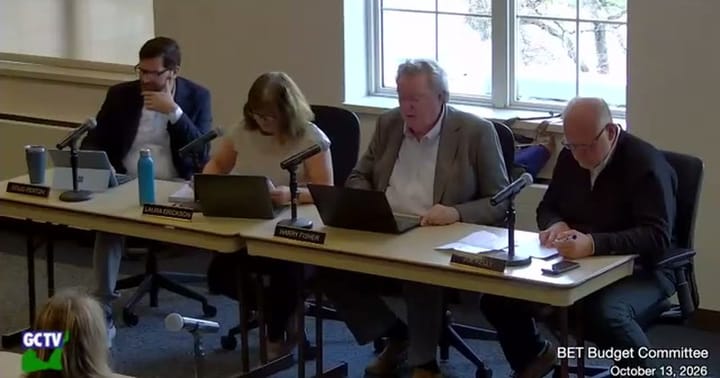
Other Committee · Meeting of October 13, 2026
GREENWICH — The Greenwich Board of Estimate and Taxation Budget Committee adopted fiscal 2028 budget guidelines on a 3-0 vote with one abstention. Member Fisher abstained, citing unresolved healthcare cost estimates and a push for stricter spending targets, while member Fenton outlined five new "deliverables," including a requirement that each department propose three cost-saving ideas. The committee also approved, 4-0 each, an $81,200 FEMA firefighter training grant and a $34,903 public health emergency preparedness grant.
Officials flagged a possible Eversource electric rate increase of up to 18 percent and a $22.3 million pension contribution that could shrink by up to $1 million. Member Tarkington said tipping fees generate roughly $2.675 million against $5.3 million in disposal costs. "There's been a lot of serious lack of movement over the past few years on fees," Fisher said.
In the full story:
- Who Was There
- Organizations And Documents Referenced
- The complete report — 2,880 words
Source: the Other Committee meeting of October 13, 2026, reported from the official video recording and transcript.
The Full Article
Fire Department FEMA Grant (FD1)
Background and stakes: the Greenwich Fire Department applied last year to the federal Assistance to Firefighters Grant program, a competitive grant drawing hundreds of applicants nationally, seeking funds to bring its pump operators and tanker shuttle crews up to a national certification standard rather than the department's current in-house, authority-having-jurisdiction standard.
The question before the body: whether to approve use of $81,200 in federal grant funds, with a required 10 percent town match.
Substantive content: Assistant Fire Chief Tom Leonard, appearing with a second assistant chief identified in the meeting only as Charlie (the transcript's rendering of the name is uncertain), told the committee the federal share is $73,818.18 and the town share is $7,381.82, which the department said it can absorb within its existing budget. The training covers the department's 60 career firefighters who drive engines, plus eligible volunteer firefighters. Leonard said the department has applied for this grant every year for the five years he has been with the Greenwich Fire Department and has now won it twice. He noted career firefighters already receive a stipend for obtaining certification, and the new national standard will not change that stipend structure; volunteers who complete the training will have their class costs reimbursed and receive a one-time stipend.
The deliberation: a member asked whether the training replaces or supplements existing in-house training and whether it affects the department's insurance rating. Leonard explained it elevates in-house training to a nationally recognized tested standard, which the committee treated as a straightforward upgrade. No member raised objections.
Procedural steps and outcome: moved by member Fisher, seconded by member Fenton, the committee voted 4-0 to approve use of the grant funds. The chair remarked, "I think we should make this routine," suggesting the item could move to a consent-type process in future years.
Implications and what is next: the grant funds training this budget year; no further committee action is anticipated unless the town's federal award amount changes.
Public Health Emergency Preparedness Grant (HD1)
Background and stakes: the town's Department of Health receives a Public Health Emergency Preparedness (PHEP) grant annually to fund the salary, fringe costs and travel expenses tied to mileage for tabletop exercises and conferences for a dedicated emergency coordinator position.
The question before the body: whether to approve use of $34,903 in PHEP grant funds, an amount the department said has held steady at this level for the past several years.
Substantive content: Deb Travers of the Department of Health (the chair later referred to her once as "Deb Edwards," an inconsistency the transcript does not resolve) told the committee the coordinator position is currently vacant. Former coordinator Dave Frasca left the role last year. The posting went out, delayed somewhat because of additional screening steps the department described only as "the AI stuff," and the department has already begun receiving applications, with interviews to start shortly.
The deliberation: committee members asked only whether the position was currently staffed; no substantive debate followed.
Procedural steps and outcome: the committee voted 4-0 to approve use of the grant funds, after a brief pause when a member asked for the dollar figure to be repeated before seconding.
Implications and what is next: the health department will proceed with hiring for the coordinator role using the grant-funded budget line; the chair thanked Travers and referenced an upcoming flu clinic.
Fiscal Year 2028 Budget Guidelines, Second Read
Background and stakes: the committee has been developing fiscal 2028 budget guidelines since a strategy memo was circulated in July and a first read occurred September 15, forty days before this meeting, which committee member Fenton described as a deliberately transparent and collaborative process. This second read incorporated member feedback and tracked changes from the prior month, including new language on service levels.
The question before the body: whether to adopt the revised guidelines, which cap level-services operating cost growth at 3.46 percent and introduce a new framework of departmental deliverables, ahead of forwarding them to the full twelve-member Board of Estimate and Taxation.
Substantive content: the chair, identified in the meeting only as Laura, walked through three exhibits prepared by the finance department. Exhibit 1, prepared over the summer by finance staff member Agnes, assumed a 3 percent utilities increase, which the chair said may be too conservative given a pending Eversource proposal to raise electric distribution rates 18 percent; a town consultant separately estimated a more likely 5 percent increase. The chair also flagged a $22.3 million pension contribution for fiscal 2028 that could be reduced by $900,000 to $1 million pending a recommendation from retirement board consultant Greg Stumpf, not yet finalized before the committee's own regular meeting, and a $6.3 million favorable variance in current-year healthcare costs that the HR committee was scheduled to review the following day. Exhibit 2 shows benefit-cost allocation for fiscal 2025 under GASB 34 standards; Exhibit 3 is a yearly benefit summary departments use to calculate benefit-loaded salary costs for new positions.
Member Fenton presented what he called five new "deliverables" built into this year's guidelines, a departure from prior incremental approaches: each department must propose three ideas for meaningful operational change or cost savings; departments must review fee structures to ensure the town is not increasing taxpayer subsidies on services; the budget should be "trued up" to better match actual spending rather than carrying unused line items; the capital plan requires review; and the first selectman's office should look for ways to break down departmental silos through shared purchasing, shared services and staff who move across departments.
The deliberation: member Fisher said he remained concerned the guidelines do not push departments hard enough on total operating costs and objected to including the capital tax levy in guidelines meant for department heads, calling it "irrelevant to the guidelines." He said he was not prepared to vote until he saw a healthcare benefits report from the town's consultant, One Digital, expected the next day, noting a gap between what his own company has seen in renewal-rate increases, 16 percent, and the confidence the town's team expressed. Fenton responded that disagreement was acceptable but that the guidelines' goals, laid out clearly, should be sufficient for department heads and schools to act on starting discussions in late January and early February. Member Kelly, who served four years on the Board of Education budget committee, said he understood Fisher's desire for more information but valued having guidelines issued early, saying late guidelines had hampered his prior committee's work. The chair pushed back on setting an arbitrarily low numeric target without departments showing how they would get there, saying a credibility gap would result: "If you don't do that, then this piece of paper won't have any credibility with the department heads." Fisher countered that unless the target itself is lowered, "you're not going to get a reaction from the department heads," arguing they will simply meet whatever ceiling is set.
Member Tarkington (rendered inconsistently in the transcript as both "Tarkington" and "Darkington") raised two additional points: a town grand list revenue growth assumption of 0.75 percent that she said should be revised upward toward 0.95 percent based on October 1 data, a change she said finance official Lauren Elliott supports after consulting with finance staff members Joan and Agnes; and a renewed concern about tipping fees, which she said raise about $2.675 million against roughly $5.3 million in disposal costs, a gap she said is not improving as recycling disposal costs approach the cost of municipal solid waste disposal. A finance-team member, identified as Doug, agreed the town needs to be thoughtful about balancing taxpayer subsidy against direct user costs as those underlying costs rise.
Member Weisbrot previewed the "three ideas" initiative's practical mechanics, describing early work he and Fisher, whom other members referred to by the first name Harry, have begun with the police department, and said BET liaisons would need to work closely with Kate Bush, described as fully supportive of and familiar with the guidelines' language, going forward. He said the real innovation is not the numeric growth target but the process of deriving efficiencies through sustained liaison work, telling colleagues, "that to me is the, if you want to say, innovation inherent in these guidelines." Member Bednar, after a brief delay getting her microphone working, said the guidelines' attention to Nathaniel Witherell and to revenue benchmarking against other municipalities were the two items she most appreciated.
The chair, closing the discussion, said the committee could not leave the work solely to the four-member Budget Committee and called for all BET liaisons to bring data and analysis back from their assigned departments: "It's unfair to say you guys go out, create a budget, and then we'll sit in the background and chirp away and snipe from the sidelines." She also referenced a nearly completed IT systems audit by outside firm CLA, to be presented Thursday, October 15, covering more than 150 town software application systems; finance staff member Joan said the audit found no major duplicate systems but recommended clarifying system ownership. BET member Matt, one of two BET representatives working with the town's AI Task Force along with Bednar, said he would report back to the committee on any audit findings relevant to the budget guidelines.
Procedural steps and outcome: on a motion to approve the fiscal 2028 budget guidelines, the committee voted 3-0 with one abstention. Fisher abstained; the chair, Fenton and Kelly voted in favor.
Implications and what is next: the guidelines, as adopted by the committee, now go to the full twelve-member Board of Estimate and Taxation, which Weisbrot said would discuss them again at its regular meeting on October 19. Department heads and the Board of Education are expected to begin working sessions with BET liaisons in late January and early February using this cap and the five-deliverable framework as their starting point.
Fiscal Year 2026 Year-End Preliminary Report and Q1 Fiscal 2027 Update
Background and stakes: the finance department presented a still-unaudited preliminary schedule of revenues and expenditures for fiscal year 2026, alongside a first-quarter report for fiscal 2027 covering July through September 30, 2026, which the chair said the committee wants to see on a regular quarterly basis.
The question before the body: an informational review, not a vote, of year-end budget performance and early fiscal 2027 trends.
Substantive content: finance staff member Agnes said building permit and conveyance tax revenue each ran 2.8 percent above fiscal 2025. Transfers in showed a $4.4 million variance tied to one-time ARPA interest and B-fund transfers made in fiscal 2025 but not repeated in fiscal 2026. On the expense side, tightened purchase-order controls produced savings, particularly in the Department of Public Works and the law department. The Board of Education finished $4.2 million better than budgeted: $1 million from unpaid teacher leave, $800,000 from unfilled paraprofessional positions, and $770,000 from special-education out-of-district settlement savings. Transfers out ran $5.9 million higher than fiscal 2025, driven by a $5 million transfer to the Nathaniel Witherell nursing home (up from $2.3 million the prior year) and a $3 million increase in Z-fund capital project transfers. Healthcare costs came in $6.3 million favorable to budget.
Within the special funds summary, Nathaniel Witherell's revenues were down $3.8 million year over year even as the facility held expenses down somewhat; staff said the facility is working with a consultant, Steven Bernier, to aggressively address expenses. Most other special funds, including parking, sewer and the golf course, ran ahead on revenue and below on expenses; school lunch was roughly break-even.
In the first-quarter fiscal 2027 figures, conveyance tax revenue and building permits were both running strong, including a single $409,000 building permit taken in during September. Member Fenton asked about an apparent lag between a reported 4.5 percent year-to-date property tax revenue growth figure and a 5.4 percent figure built into the budget, a gap finance staff said they would research further. Staff also noted the town's revenue-posting systems remain largely manual, creating a multi-week lag in recorded figures, which the chair's staff (a finance team member identified only as Natasha was addressed briefly near the close of this discussion) suggested could be addressed through operational investment, a comment that dovetailed with the three-ideas deliverable adopted earlier in the meeting.
The deliberation: member Tarkington asked finance staff to show more clearly where fee-related revenue appears within the budgetary schedule; staff pointed her to a second summary page breaking out revenue by category (taxes, licenses and permits, charges for services) and offered to follow up with her individually. Fisher reiterated his recurring point that tipping fee revenue, about $2.675 million, remains far below the roughly $5.3 million cost of waste removal, calling the disparity a cost that should fall more on users of the town's disposal facility rather than general taxpayers. DPW-liaison member Doug agreed the imbalance needs attention as underlying disposal costs rise.
Procedural steps and outcome: no vote was taken on the financial reports; they were presented for discussion only.
Implications and what is next: finance staff said they intend to move the quarterly reporting cycle earlier, beginning the transfer-in process in July rather than December, to reduce timing-driven variances in future reports.
Minutes, Chair Report and Adjournment
Background and stakes: routine closing business.
Substantive content and outcome: the committee voted unanimously to approve the minutes of its September 15, 2026 meeting. The chair said she had no chair report this month and that a planned discussion of the town's authorized-but-unissued bonds would be postponed to the following month's meeting to finalize some figures. On a motion by member Kelly, seconded and approved unanimously, the meeting adjourned at 1:56 p.m.
Budget Committee Chair, identified only by the first name Laura — presided over the meeting, presented Exhibit 1-3 financial assumptions. Member Fisher — voted, abstained on the budget guidelines vote. Member Fenton — voted, presented the five-deliverable framework. Member Kelly — voted, drew on prior Board of Education budget committee experience.
Other Board of Estimate and Taxation members present (not members of the four-person Budget Committee): Member Weisbrot; Member Bednar (addressed as Sally); Member Tarkington, also rendered "Darkington" in the transcript (addressed once as Leslie); a member identified only as Matt; a member identified only as Doug.
Staff in attendance: Assistant Fire Chief Tom Leonard; a second assistant fire chief identified in the transcript as Charlie, surname uncertain; Deb Travers of the Department of Health, referred to once in the transcript as "Deb Edwards"; finance department staff identified only by first name as Agnes and Joan; a finance staff member addressed briefly as Natasha.
Mentioned but not present: Dave Frasca, former public health preparedness coordinator; Caroline, health department staff screening job applications; Greg Stumpf, retirement board pension consultant; Kate Bush, described as supportive of and familiar with the budget guidelines; Lauren Elliott, finance official supportive of a grand list assumption change; Jim Michael, Department of Public Works contact on the tipping fee contract; Steven Bernier, consultant assisting Nathaniel Witherell on expense reduction.
FEMA Assistance to Firefighters Grant program — federal grant funding the fire department training item, FD1. Public Health Emergency Preparedness (PHEP) grant — federal/state funding for the health department's emergency coordinator position, HD1. Eversource — utility proposing an 18 percent electric distribution rate increase, cited as a risk to the guidelines' 3 percent utilities assumption. PURA (Public Utilities Regulatory Authority) — cited by the chair regarding 15-18 percent energy cost increases and up to 35 percent distribution increases in high-voltage areas including Greenwich public schools. One Digital — healthcare benefits consultant whose initial cost estimate was expected in November, possibly previewed the day after this meeting. Retirement board / consultant Greg Stumpf — pension cost review cited in the $22.3 million contribution discussion. CLA — outside audit firm presenting IT systems audit findings October 15, covering more than 150 town application systems. AI Task Force — developing guidelines/safeguards for AI use in budget submissions; BET liaisons Matt and Bednar. Debt and Fund Balance Committee — cited regarding the capital tax levy and debt guideline compliance risk starting fiscal 2031. Nathaniel Witherell — town-owned nursing home with a $7.7 million negative fund balance, discussed in both the guidelines debate and the year-end financial report. Board of Education — discussed regarding fiscal 2027 transportation costs, an unresolved fiscal 2028 bus and parking cost question, and a $4.2 million favorable fiscal 2026 budget variance. Department of Public Works — discussed regarding tipping fees, recycling disposal cost increases, and a lagging capital plan for fiscal 2028. Representative Town Meeting (RTM) — noted as a body that, along with the Board of Selectmen, would have advance notice if DPW pursues a residential disposal permit for Holly Hill. September 15, 2026 meeting minutes — approved at this meeting. Preliminary fiscal year 2026 schedule of revenues and expenditures — unaudited year-end financial report presented and discussed. First-quarter fiscal 2027 financial report — presented covering July 1 through September 30, 2026. Exhibits 1, 2 and 3 — finance department budget-guideline backup materials on cost assumptions and benefit allocation, prepared by finance staff member Agnes. July strategy memo — prior document outlining the BET's budget direction ahead of the formal guidelines.
Share this story
Know someone in Greenwich who follows town government? Share Townbrief Greenwich: they can sign up free.